Introduction
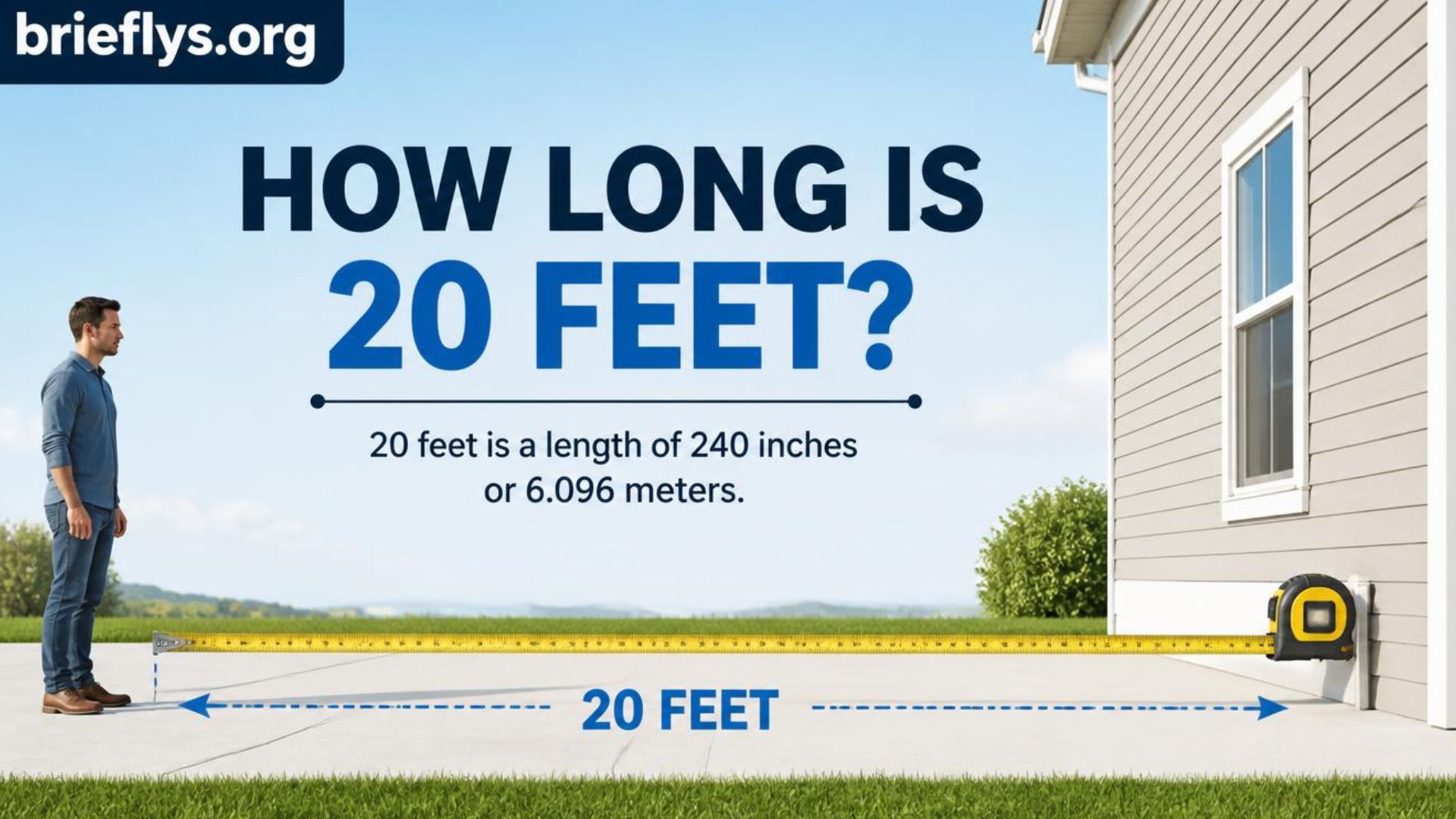
Twenty feet is a useful measurement for understanding distances in homes, driveways, gardens, construction projects, and storage spaces. Although it can be difficult to visualize this length at first, comparing it with familiar objects makes it easier to understand.
According to the National Institute of Standards and Technology (NIST), one international foot equals exactly 0.3048 meters. Therefore, 20 feet is equal to 6.096 meters, or approximately 6.1 meters.
This guide explains how long 20 feet is, how to convert it into other units, how to estimate the distance by counting steps, and which real-world examples can help you visualize it. It also provides practical measuring tips, useful facts, and multiple-choice questions to test your understanding.
How Long Is 20 Feet?
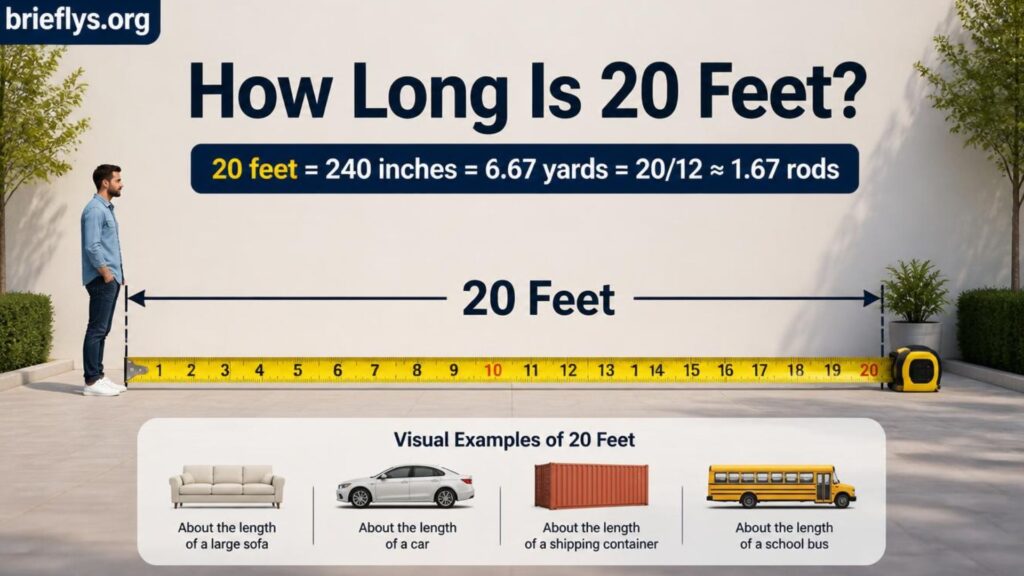
Twenty feet is a linear measurement equal to 240 inches, 6.096 meters, or approximately 6.67 yards. It is commonly used when measuring rooms, outdoor spaces, building materials, vehicles, and storage areas.
These conversions are useful when working with measurements provided in different units.
It is also important to distinguish length from area. For example, a rectangular space measuring 20 feet long and 10 feet wide has an area of 200 square feet. The length alone does not determine the total area.
How Many Inches, Meters, Centimeters, and Yards Are in 20 Feet?
- Converting 20 feet into other units is straightforward.
- Feet to inches: Multiply 20 by 12 to get 240 inches.
- Feet to yards: Divide 20 by 3 to get approximately 6.67 yards
- Feet to meters: Multiply 20 by 0.3048 to get 6.096 meters.
- Feet to centimeters: Multiply 20 by 30.48 to get 609.6 centimeters.
- Feet to millimeters: Multiply 20 by 304.8 to get 6,096 millimeters.
- These calculations can help you measure furniture, plan renovations, compare product dimensions, and estimate the length of materials needed for a project.
How Can You Visualize a Length of 20 Feet?
One practical example is a standard 20-foot shipping container. According to Maersk’s published equipment specifications, a standard container has a nominal external length of 20 feet. Its internal length is shorter because of the container’s construction.
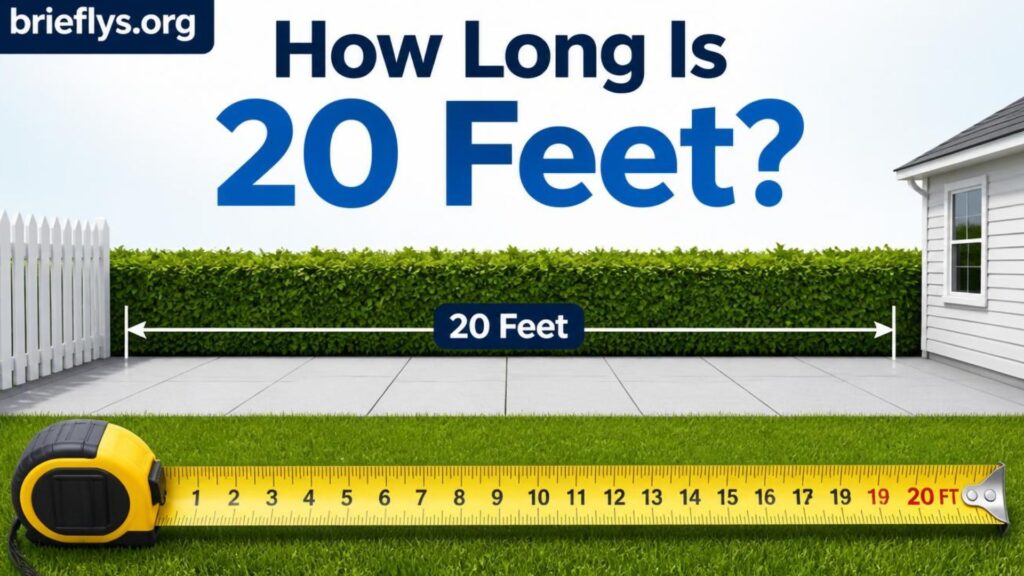
You can also visualize 20 feet by marking a straight line across a driveway, garden, or open indoor space. Seeing the distance marked on the ground can make the measurement easier to understand.
Remember that comparisons are useful for visualization, but you should measure an object directly when its exact dimensions matter.
How Can You Measure 20 Feet by Counting Your Steps?
Counting your steps is a convenient way to estimate 20 feet when you do not have a measuring tape. However, the result depends on your stride length, walking speed, and consistency.
For example, if each step covers approximately 2 feet, you would need about 10 steps to cover 20 feet. If each step covers 2.5 feet, you would need about 8 steps.
These examples are estimates rather than universal measurements because everyone’s stride is different.
How Many Steps Does It Take to Walk 20 Feet?
Your actual result may differ because step length changes with walking speed, terrain, footwear, and natural movement.
How Can You Improve the Accuracy of Step-Based Measurements?
- You can make step-based estimates more reliable by measuring your average stride length.
- Mark a straight 10-foot distance using a measuring tape.
- Walk from one end to the other at your normal pace.
- Count your steps and repeat the process several times.
- Calculate your average step length.
- Use that average to estimate how many steps you need to cover 20 feet.
For example, if you take five steps to cover 10 feet, your average step length is 2 feet. You would therefore need approximately 10 similar steps to cover 20 feet.
This method is useful for rough estimates, but a measuring tape or suitable distance meter is more reliable when precision is important.
What Common Things Are 20 Feet Long or Big?
Comparing 20 feet with familiar objects can make the measurement easier to picture. A standard 20-foot shipping container is a particularly useful example because its nominal external length is specified by the manufacturer.
Other examples, such as driveways, rooms, fences, and recreational spaces, can help you visualize the distance. However, their dimensions vary, so they should not be treated as exact 20-foot measurements without verification.
Which Everyday Objects and Vehicles Measure Around 20 Feet?
1. A standard shipping container
A standard 20-foot shipping container has a nominal external length of 20 feet. It provides a reliable reference for visualizing this distance. Its internal usable length is shorter, so check the manufacturer’s specifications when planning storage.
2. A section of a driveway
A marked 20-foot section of a driveway provides a practical example of the distance. Driveways come in different sizes, so measuring the endpoints is more reliable than estimating the length by sight.
3. A long room
Some rooms have a dimension close to 20 feet. Measuring from one wall to the opposite wall helps determine whether the space is suitable for furniture, equipment, or renovation plans.
Vehicles, trailers, and recreational equipment may also have lengths near 20 feet. However, dimensions vary by model, so consult the manufacturer’s specifications before using a vehicle as a reference.
What Large Structures and Spaces Can Help You Visualize 20 Feet?
4. A section of garden fencing
A straight fence section measuring 20 feet can help you visualize the distance across a yard. Remember that fence length and fence height are two different measurements.
5. A patio or paved area
A patio with one side measuring 20 feet offers another practical comparison. Its total area depends on the length of the other side.
6. A swimming pool or recreational space
Some swimming pools and recreational areas have dimensions close to 20 feet. However, sizes vary considerably, so check the actual measurements before using them as a reference.
Among these examples, a standard shipping container is the most reliable comparison because its nominal external length is defined by its specifications. The other examples are useful for visualization but require direct measurement for accuracy.
What Additional Factors Should You Consider When Measuring 20 Feet?
The best way to measure 20 feet depends on the task. Estimating a distance for general planning requires less precision than measuring a space for construction, installing equipment, or purchasing materials.
NIST provides standard conversion factors that help users convert between customary and metric measurements. Applying the correct conversion factor reduces the risk of errors when working with different measurement systems.
How Do Measurement Tools Compare for Accuracy?
- Different measuring tools are suitable for different situations.
- Furniture, indoor spaces, and DIY projects
- Keep the tape straight and properly aligned.
- Laser distance meter
- Rooms and longer indoor distances
- Follow the manufacturer’s instructions.
- Longer distances across accessible ground
- Uneven surfaces can affect readings.
- Quick estimates without equipment
- Accuracy depends on stride length.
- Ruler or measuring stick
- Short distances
- Repeated placement can introduce errors.
For an accurate 20-foot measurement, use a tape measure long enough to span the entire distance or a suitable distance meter. If you must measure in sections, mark each endpoint carefully to avoid gaps or overlaps.
Why Can Estimated Measurements Differ From Actual Lengths?
Several factors can affect measurement accuracy:
- Uneven Surfaces: The slope of land and any uneven surface can cause problems when measuring horizontal distance.
- Incorrect alignment: A bent or diagonal measuring tape may produce an inaccurate reading.
- Tool Limitations: The measuring tool can be limited in range or calibration.
- Conversion mistakes: Confusing feet with inches or meters can create significant errors.
- Different dimensions: An object’s external length may differ from its internal usable length.
For home improvement and construction projects, determine whether you need the external dimensions of an object, its internal usable dimensions, or the distance between two fixed points. This distinction helps prevent mistakes when ordering materials or checking whether an item will fit in a particular space.
What Are the Most Important Facts About 20 Feet?
Here are the key facts to remember:
- 20 feet equals 240 inches.
- 20 feet equals 6.096 meters, or approximately 6.1 meters.
- 20 feet equals 609.6 centimeters.
- 20 feet equals 6,096 millimeters.
- 20 feet equals approximately 6.67 yards.
- The 20-foot cargo container is a relevant real-life example despite the fact that its internal length is less than its external length.
- Taking steps can help us measure twenty feet, although the step varies from person to person.
- A measuring tape or suitable distance meter is preferable when accurate measurements are required.
- These facts make it easier to convert, visualize, and measure 20 feet in everyday situations.
What Are Some Common Multiple-Choice Questions About 20 Feet? (MCQs)
1. How many inches are in 20 feet?
A. 120 inches
B. 240 inches
C. 200 inches
D. 360 inches
Correct answer: B. 240 inches
2. How many meters are in 20 feet?
A. 6.096 meters
B. 2.096 meters
C. 20 meters
D. 60.96 meters
Correct answer: A. 6.096 meters
3. How many yards are in 20 feet?
A. 10 yards
B. 20 yards
C. Approximately 6.67 yards
D. 5 yards
Correct answer: C. Approximately 6.67 yards
4. Which object is a useful real-world comparison for 20 feet?
A. A standard 20-foot shipping container
B. A sheet of paper
C. A teaspoon
D. A typical pencil
Correct answer: A. A standard 20-foot shipping container
5. If each step covers 2 feet, approximately how many steps are needed to cover 20 feet?
A. 5 steps
B. 8 steps
C. 10 steps
D. 20 steps
Correct answer: C. 10 steps
6. Which tool is suitable for accurately measuring a 20-foot distance?
A. A visual guess
B. A tape measure long enough to cover the distance
C. An ordinary pencil
D. An uncalibrated step estimate
Correct answer: B. A tape measure long enough to cover the distance
7. How many centimeters are in 20 feet?
A. 60.96 centimeters
B. 609.6 centimeters
C. 6,096 centimeters
D. 240 centimeters
Correct answer: B. 609.6 centimeters
8. Is the internal usable length of a standard 20-foot shipping container exactly 20 feet?
A. Always
B. Yes, in every model
C. No, it is generally shorter than the nominal external length
D. Only when the container is empty
Correct answer: C. No, it is generally shorter than the nominal external length
What Is the Summary of How Long 20 Feet Is?
Twenty feet equals 240 inches, 6.096 meters, 609.6 centimeters, and approximately 6.67 yards. These conversions make it easier to understand the measurement in both customary and metric units.
A standard 20-foot shipping container provides a useful way to visualize the distance. You can also estimate 20 feet by counting your steps, provided you know your approximate stride length. However, step counting is less reliable than using a measuring tape or suitable distance meter.
When measuring for construction, storage, furniture placement, or outdoor projects, consider the surface, alignment, and whether you need an internal or external dimension. Understanding these factors helps you avoid mistakes and plan more accurately.