introduction
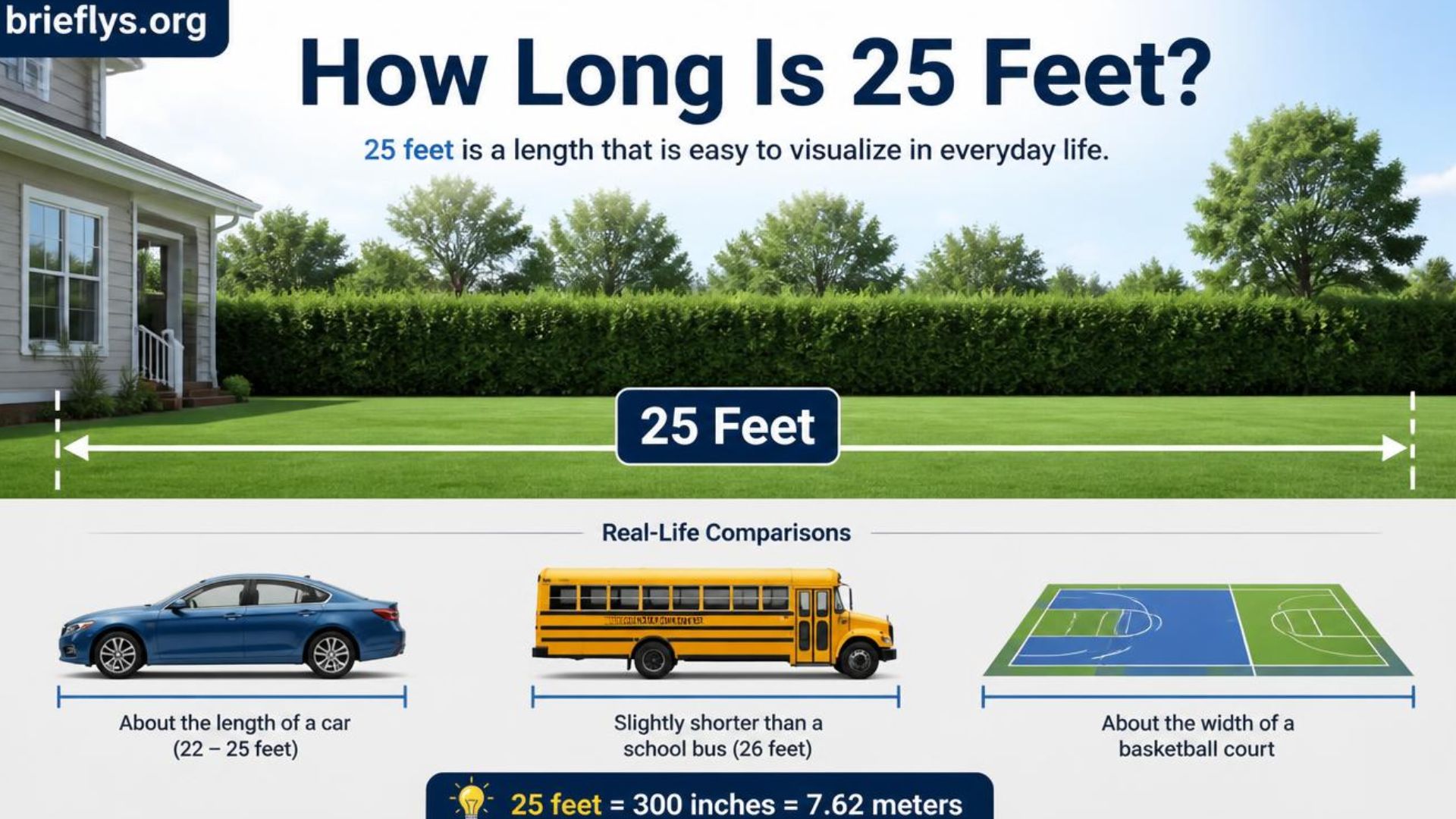
Twenty-five feet may sound like a simple measurement, but it can be difficult to picture until you compare it with familiar distances and objects. Whether you are planning a garden, measuring a driveway, arranging furniture, or estimating space for a large item, understanding what 25 feet looks like can make the task easier.
25 feet equals 300 inches, 8⅓ yards, 7.62 meters, or 762 centimeters. It is slightly longer than 7.5 meters, making it a useful measurement to visualize in both customary and metric units.
You can estimate this distance by counting your walking steps, dividing it into smaller sections, or using an object with a known length. These methods work well for rough estimates, although a measuring tape or laser distance meter is preferable when accuracy matters.
How Long Is 25 Feet? An Introduction to This Measurement
A distance of 25 feet stretches across a substantial section of an outdoor area. It may represent the length of a recreational boat, a measured section of a driveway, or a straight garden path. The exact comparison depends on the dimensions of the object or space you are using.
One way to imagine 25 feet is to picture a straight line with a marker at each end. The distance between those markers would be 25 feet, regardless of whether the line crosses a lawn, garage, room, or parking area.
What Does 25 Feet Look Like in Everyday Life?
Think of 25 feet as a distance that requires several ordinary walking steps rather than just one or two. If you divide it into five equal sections, each section will measure 5 feet. Together, the sections create the complete 25-foot length.
This method is helpful because smaller distances are often easier to estimate. You can imagine one 5-foot section and repeat it five times instead of trying to visualize the entire length at once.
You can also compare the distance with a long object whose measurements are known. For example, a boat advertised as 25 feet long offers a direct reference. However, a boat measuring 24 feet or 26 feet would only be an approximation.
Where Might You Encounter a 25-Foot Distance?
You may encounter a 25-foot measurement in several practical situations:
- Home improvement: Estimating the length of a wall, driveway, or outdoor area.
- Gardening: Marking planting rows, paths, or boundaries.
- Storage: Checking whether a long object can fit in a garage or storage area.
- Recreation: Understanding the length of a boat, camper, or other large item.
- Event planning: Estimating the distance between seating areas, signs, or temporary markers.
- Landscaping: Planning where to place plants, decorative features, or outdoor equipment.
These examples are starting points rather than standard dimensions. Measure the actual space or check the manufacturer’s specifications before purchasing materials or deciding whether an object will fit.
How Does 25 Feet Translate Into Other Units of Measurement?
Converting 25 feet into other units makes the measurement easier to understand, especially when working with metric dimensions.
The National Institute of Standards and Technology states that the international foot equals exactly 0.3048 meters. It also documents the relationships used to convert customary measurements into metric units.
How Many Inches, Yards, and Meters Are in 25 Feet?
These calculations use standard international units. For technical work involving historical U.S. surveying records, be aware that the former U.S. survey foot differs slightly from the international foot. NIST states that the U.S. survey foot was retired for general use beginning January 1, 2023.
How Can You Convert 25 Feet Into Metric Units?
If you normally use meters and centimeters, the most useful conversion is:
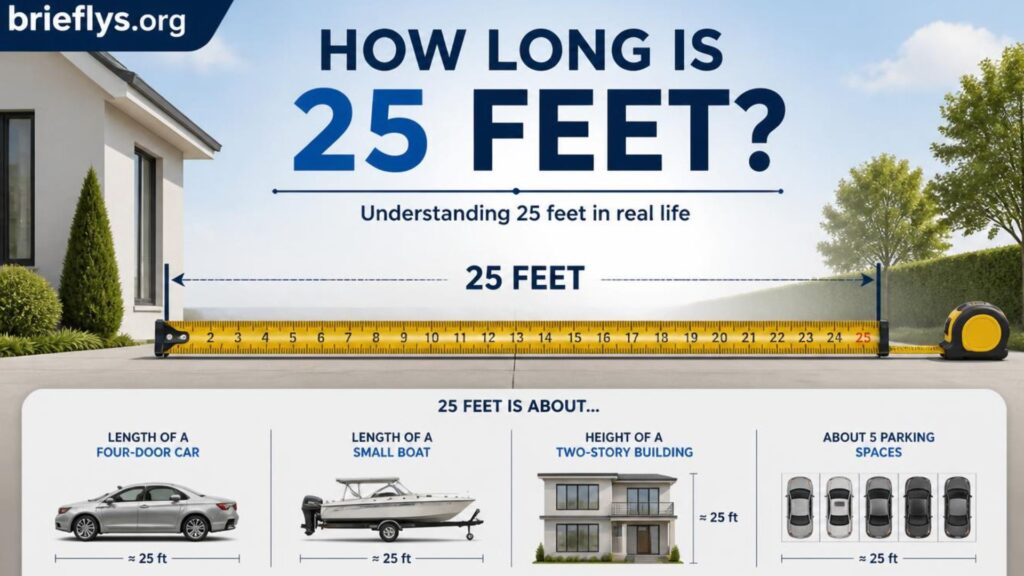
25 feet = 7.62 meters = 762 centimeters.
To convert any measurement in feet into meters, multiply the number of feet by 0.3048.
For example, suppose you want to convert 15 feet into meters:
15 × 0.3048 = 4.572 meters
The same formula works for 25 feet:
25 × 0.3048 = 7.62 meters
For a quick mental estimate, you can think of 25 feet as approximately 7.6 meters. This rounded figure is convenient for visualizing space, but use 7.62 meters when you need the exact conversion.
It is also important to distinguish length from area. A measurement of 25 feet describes a distance in one direction. A space measuring 25 feet by 10 feet has an area of 250 square feet, not 25 square feet.
Why Does 25 Feet Feel Bigger Than the Number Sounds?
The number 25 is familiar, but the unit makes a significant difference. Twenty-five inches is only 2 feet and 1 inch, while 25 feet equals 300 inches. The same number can describe very different physical distances depending on the unit.
Perspective also influences how you judge a space. A straight distance across an open lawn may be easier to visualize than a distance running diagonally through a room filled with furniture.
How Does Perspective Affect Your Perception of 25 Feet?
When you stand at one end of a 25-foot space, the distance may appear shorter or longer depending on the surroundings. Objects placed between the endpoints can help you judge the scale, while visual obstructions may make the distance harder to estimate.
A long, unobstructed line is generally easier to judge than a path with turns. If you need to estimate a straight distance, identify the starting and ending points first.
For example, imagine a garden that extends from a patio to a fence. If the distance is 25 feet, you can mark the midpoint at 12.5 feet. This divides the space into two equal sections and makes the overall length easier to visualize.
Why Do Familiar Objects Make This Distance Easier to Imagine?
Familiar objects give you a reference point. A measuring tape marked at 25 feet is the clearest example, but a measured rope, garden hose, or extension cord can also help if its stated length is known.
A row of smaller objects can provide another comparison. If you have tables or other items with measured lengths, add their dimensions together to estimate the total length. Remember to account for gaps between the objects.
Avoid assuming that all objects in a category have the same dimensions. Vehicles, trailers, boats, and ladders vary by model, so use a manufacturer’s specification sheet when the exact length matters.
How Can You Estimate 25 Feet Without a Tape Measure? Three Quick Methods
You can estimate 25 feet without a measuring tape by pacing the distance, dividing it into smaller sections, or using a familiar object as a reference. Each method provides a rough estimate, but its accuracy depends on how carefully you apply it.
How Can You Use Your Walking Steps to Estimate 25 Feet?
The pacing method involves walking along a straight line and counting your steps. The Food and Agriculture Organization explains that pacing can be used to estimate distances, but you should know your average step length to improve the result.
Follow these steps:
- Find a clear, reasonably flat area.
- Measure a short distance, such as 10 feet, if a measuring tool is available.
- Walk normally across that distance and count your steps.
- Repeat the process several times and calculate your average.
- Use your average step length to estimate how many steps cover 25 feet.
For example, suppose your average step length is 2.5 feet. The calculation would be:
25 ÷ 2.5 = 10 steps
Under that assumption, approximately 10 steps would cover 25 feet.
This is an example calculation, not a universal walking standard. Your step length may change with your height, pace, footwear, and the surface you walk on. Soft ground, slopes, and obstacles can also affect the result.
How Can You Use Familiar Objects or Divide the Distance Into Sections?
If pacing is inconvenient, use a reference method instead.
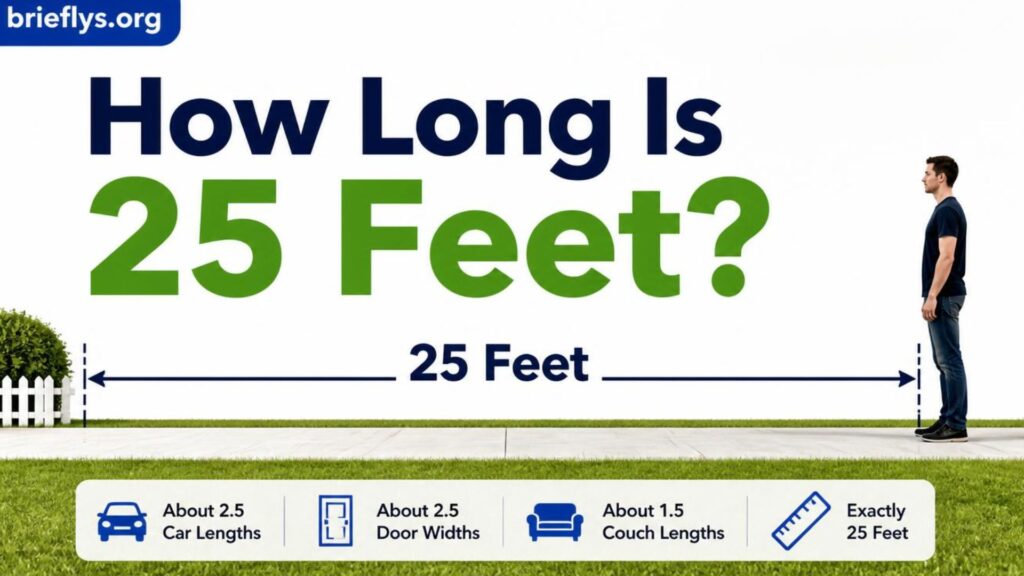
Method 1: Divide the distance into five sections
Imagine five consecutive sections, each measuring 5 feet:
5 + 5 + 5 + 5 + 5 = 25 feet
This approach works well when marking a garden or planning a room. If you have a 5-foot measuring stick or another verified reference, move it along the line to establish each section.
Method 2: Use a measured rope
A rope cut or marked at 25 feet can serve as a portable reference. Stretch it in a straight line between the two endpoints. Avoid leaving loops or bends because they make the visible distance shorter than the rope’s total length.
Method 3: Compare a known object
Use an object with published dimensions, such as a boat or trailer, as a reference. Check the actual model length rather than assuming all similar objects are the same size.
Method 4: Mark the endpoints
Place two markers where you estimate the distance begins and ends. If possible, verify the measurement later with a tape measure or laser distance meter.
Pacing and visual comparisons are useful for planning, but do not rely on them alone for construction, safety clearances, or installations that require a precise fit.
What Are the Most Important Facts About 25 Feet?
The following facts summarize the most useful information about this measurement.
Additional points to remember:
- Twenty-five feet is a length, not an area.
- A distance of 25 feet can be divided into five equal sections of 5 feet.
- Walking steps can provide a rough estimate if you know your average step length.
- Objects such as boats and trailers are only useful comparisons when their dimensions are known.
- Rounding 7.62 meters to 7.6 meters is convenient for everyday estimates but may not be precise enough for detailed work.
What Are the Most Common Multiple-Choice Questions (MCQs) About 25 Feet?
1. How many inches are in 25 feet?
A. 200 inches
B. 250 inches
C. 300 inches
D. 350 inches
Correct answer: C. 300 inches
2. How many meters equal 25 feet?
A. 5.62 meters
B. 7.62 meters
C. 8.25 meters
D. 10 meters
Correct answer: B. 7.62 meters
3. How many yards are in 25 feet?
A. 6⅓ yards
B. 7 yards
C. 8⅓ yards
D. 10 yards
Correct answer: C. 8⅓ yards
4. Which calculation converts feet into inches?
A. Multiply by 3
B. Multiply by 12
C. Divide by 12
D. Multiply by 100
Correct answer: B. Multiply by 12
5. What is 25 feet in centimeters?
A. 250 centimeters
B. 500 centimeters
C. 762 centimeters
D. 1,000 centimeters
Correct answer: C. 762 centimeters
6. Which method can help estimate 25 feet without a tape measure?
A. Counting steps using an estimated step length
B. Measuring the temperature
C. Counting minutes on a clock
D. Weighing an object
Correct answer: A. Counting steps using an estimated step length
7. Why can pacing produce an inaccurate measurement?
A. Feet cannot be converted into meters
B. Everyone has the same stride
C. Step length changes between people and conditions
D. Pacing only works indoors
Correct answer: C. Step length changes between people and conditions
8. How many equal 5-foot sections make 25 feet?
A. Three
B. Four
C. Five
D. Six
Correct answer: C. Five
9. Which value is closest to 25 feet in meters?
A. 2.5 meters
B. 5 meters
C. 7.62 meters
D. 25 meters
Correct answer: C. 7.62 meters
10. What is the most suitable tool for accurately checking a 25-foot distance?
A. A thermometer
B. A measuring tape
C. A weighing scale
D. A clock
Correct answer: B. A measuring tape
What Is the Summary of How Long 25 Feet Is?
Twenty-five feet equals 300 inches, 8⅓ yards, or exactly 7.62 meters. It is a useful distance to understand when estimating outdoor spaces, planning a garden, checking storage dimensions, or working with measurements given in feet.
To visualize the distance, divide it into five sections of 5 feet each, estimate it by pacing, or compare it with an object whose length is known. Pacing can be useful for a rough estimate, but a measuring tape or laser distance meter is a better choice when accuracy matters.
Once you remember that 25 feet is just over 7.5 meters, it becomes easier to picture the distance and convert it into other units.