introduction
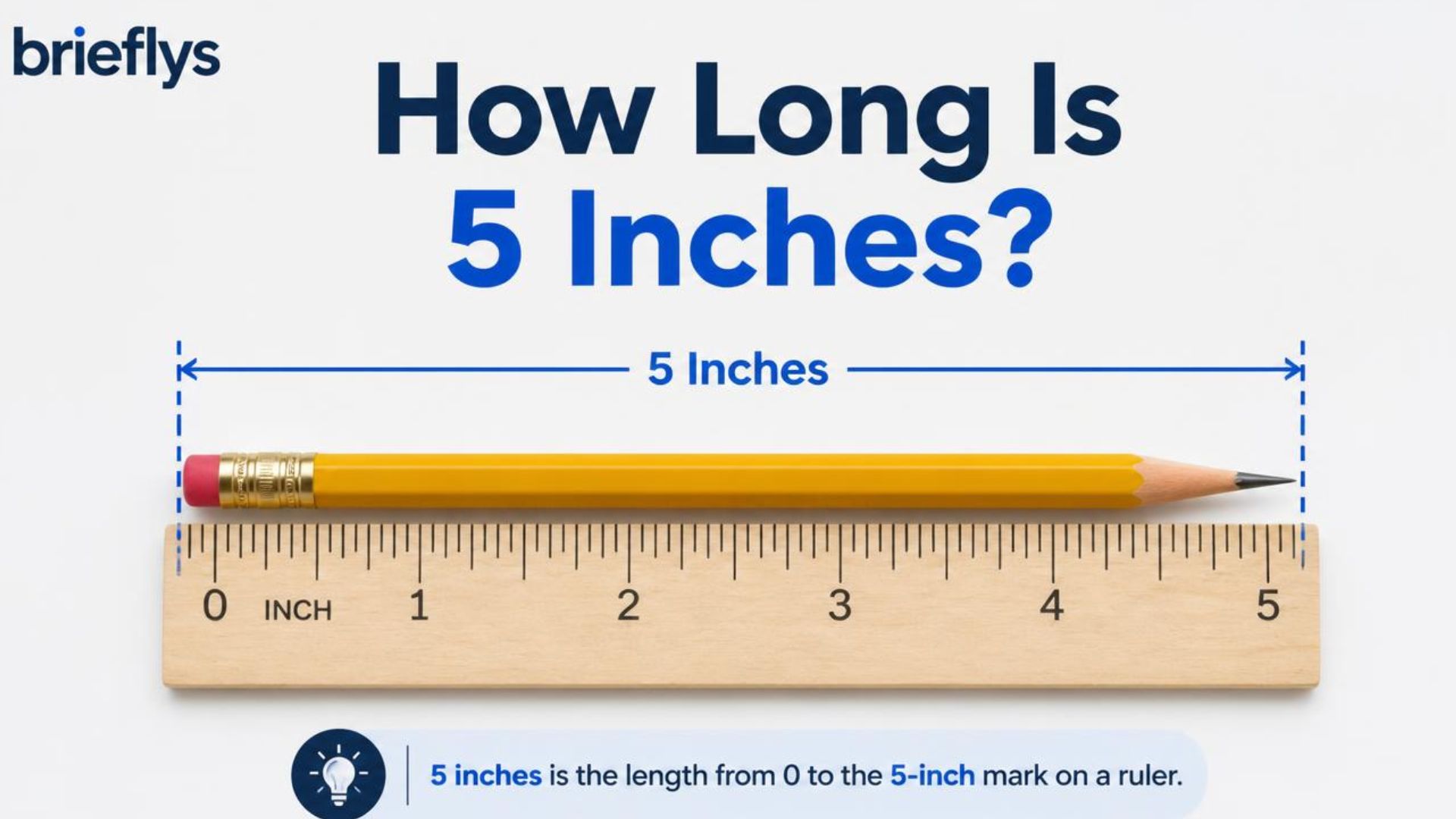
Knowing how long 5 inches is can help you estimate the size of everyday objects, choose the right product, complete DIY projects, and understand measurements without always reaching for a ruler. If you’re wondering How Long Is 5 Inches, seeing this length next to familiar items makes it much easier to picture. Although five inches may sound like a small distance, comparing it with everyday objects helps you understand its actual size.
Five inches equals 12.7 centimeters or 127 millimeters. The National Institute of Standards and Technology (NIST) confirms the conversion factor of 2.54 centimeters per inch. This means you can convert inches to centimeters by multiplying the measurement by 2.54.
In this guide, you will be introduced to the true appearance of 5 inches, its comparison with your hand, common objects that can be used for estimating this measurement, and how to measure it without a ruler.
What Is the Significance of 5 Inches in Real Life?
Five inches is a measurement that can be applied to measure the size of an object.. It is equal to 12.7 centimeters, making it a little longer than 12 centimeters and just under 13 centimeters.
To picture this measurement, imagine a straight line extending 5 inches from one point to another. While it is larger in width than an average credit card, it is much smaller in size than a normal ruler that is one foot in length.
The important thing to remember is that length and width are different. An object may be five inches long but considerably wider or thicker. Similarly, a screen advertised as five inches may refer to its diagonal measurement rather than its height or width.
How Many Inches Are in 5 Inches?
Five inches measures exactly 12.7 centimeters. If you use the metric system more often, visualizing a length of approximately 13 centimeters can make this measurement easier to understand.
Here are a few ways to picture it:
- On a ruler: Five inches covers five one-inch intervals starting at the zero mark.
- In centimeters: The same distance is 12.7 cm.
- As part of a foot: Five inches is five-twelfths of a foot, or approximately 41.7% of a foot.
- When compared to a 10-inch object: Five inches is exactly half its size.
- Imagine marking a point at zero on a ruler and another at five inches. The distance between those marks—not the ruler’s total length—is the measurement you need.
- Remember that 5 inches is an exact measurement, while comparisons with household items are usually approximate unless the item’s dimensions are known.
How Big Is 5 Inches in Relation to Your Hand?
Your hand can be a convenient reference for estimating five inches, but it is not a universal measuring tool. Hand dimensions differ from person to person, so a measurement that matches one person’s hand may be noticeably different for someone else.
Here are three practical ways to compare your hand with five inches:
- Across your palm: Look at the width of your palm and compare it with a five-inch reference. Your palm may be narrower or wider.
- From your fingertips to a palm crease: This distance varies according to finger length and hand size, so use it only as a rough estimate.
- Across your thumb and fingers: Stretch your thumb and fingers apart and observe the span. This can help you visualize a distance, but it is not a reliable substitute for a ruler.
- For a better personal reference, measure five inches once using a ruler. Then compare that distance with your own hand. You will have a more useful estimate for situations when a measuring tool is unavailable.
14 Common Objects That Measure Approximately 5 Inches in Length
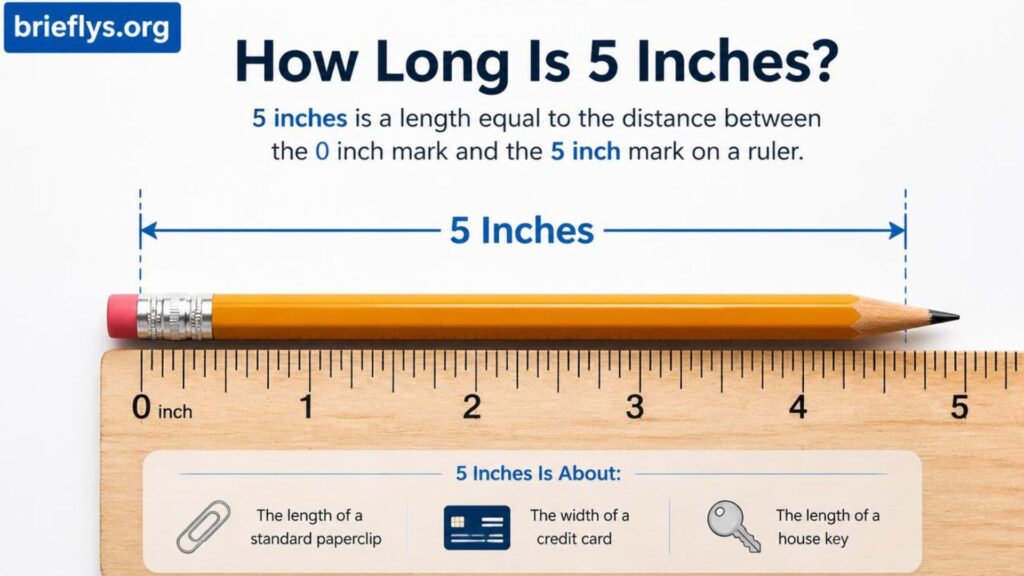
Everyday objects can help you picture five inches, but their dimensions are not always standardized. The following examples include fixed-length references, portions of larger objects, and items that may be close to five inches depending on their design.
No.
The first five examples are especially useful because they rely on a known dimension or a simple half-length calculation. The other examples are visual estimates, not universal product specifications. Actual sizes vary by brand, model, and design.
What Home Goods Make the Best 5-Inch Comparisons?
A standard 3 × 5-inch index card is one of the most convenient references because its longer side is five inches. A measured strip of paper is another useful option, particularly if you do not have a ruler available.
If you use a phone, remote control, or other household item, check its specifications first whenever accuracy matters. Two objects that look similar can have different dimensions.
How Does 5 Inches Compare to Similar Measurements?
Comparing five inches with nearby measurements helps you understand small differences in length.
These conversions use the exact relationship of 1 inch = 2.54 centimeters, as documented by NIST.
How Does 5 Inches Compare to 4 and 6 Inches?
Five inches sits directly between four and six inches.
The difference between four and five inches is one inch, equivalent to 2.54 centimeters. The difference between five and six inches is also one inch.
This may seem like a small change, but it can matter when measuring a shelf opening, selecting a replacement part, checking a product’s dimensions, or cutting material to fit a particular space.
How Many Centimeters Is 5 Inches?
Five inches equals 12.7 centimeters.
The calculation is straightforward:
5 × 2.54 = 12.7 cm
You can use the same method for other inch measurements. For example, four inches equals 10.16 centimeters, while six inches equals 15.24 centimeters.
For most everyday estimates, you can think of five inches as approximately 13 centimeters. For precise work, use the exact value of 12.7 centimeters.
Why Is Knowing the Length of 5 Inches Useful in Everyday Life?
Understanding five inches can make everyday measuring tasks easier. You might need to estimate the dimensions of a phone accessory, check whether an item will fit in a small storage space, or decide how much material to cut for a craft project.
This knowledge is also helpful when shopping online. Product descriptions may list dimensions in inches even when you are more familiar with centimeters. Converting five inches to 12.7 centimeters allows you to compare products using a measurement system you understand.
Five inches can also be useful in:
- Home projects: Estimating short gaps, clearances, and small decorative pieces.
- Crafting: Measuring ribbon, paper, fabric, and other materials.
- Schoolwork: Practicing unit conversion and basic measurement.
- Product comparisons: Understanding listed lengths before purchasing an item.
- Packing and storage: Estimating whether small objects will fit in a particular space.
- For any task where a small error could cause a problem, use an actual measuring tool rather than relying solely on visual estimation.
What Are the Best Ways to Measure 5 Inches Without a Ruler?
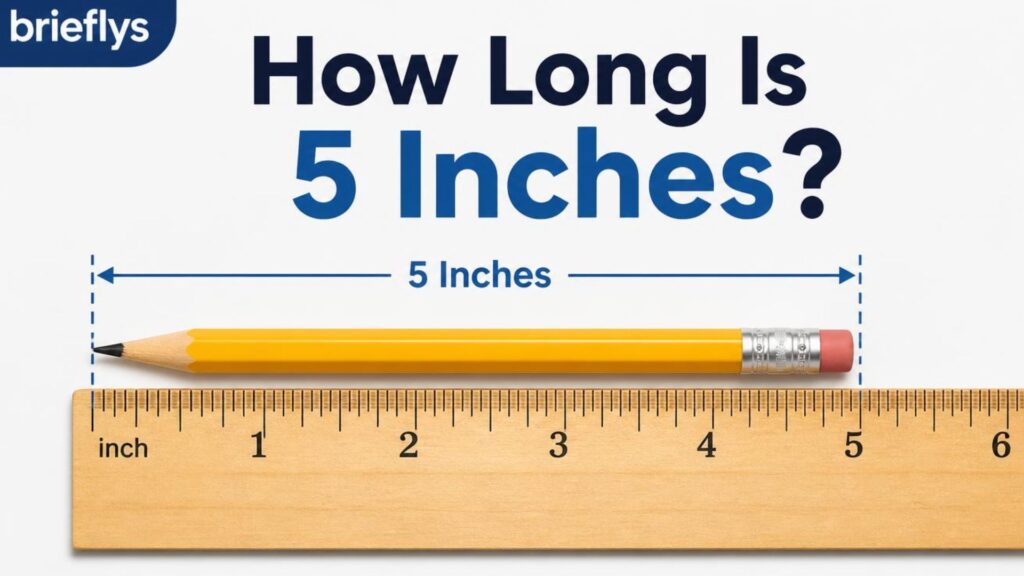
You can estimate or reproduce a five-inch length without owning a ruler. The best method depends on whether you need a rough visual comparison or a more precise measurement.
Using Your Hand or Fingers as a Quick Reference
Your hand can help you estimate five inches once you know its dimensions. However, do not assume that your palm, thumb, or finger span automatically equals five inches.
For a simple method, measure a five-inch length with a ruler when one is available. Compare it with your hand and remember the relationship. Later, you can use that comparison to make rough estimates.
This approach is convenient when shopping, working on small projects, or trying to picture a measurement without a measuring tool.
Using Everyday Objects to Estimate 5 Inches
A standard 3 × 5-inch index card provides a convenient reference because its longer edge is five inches. You can also use a strip of paper whose length has already been measured.
Another option is to take an object known to be ten inches long and divide it into two equal sections. Each half will measure five inches.
Avoid assuming that an unmeasured phone, pencil, or household item has a standard length. These objects vary, and even a small difference can affect your estimate.
Creating a Simple 5-Inch Reference Using Common Items
If you need to mark five inches on paper, cardboard, or another material, follow these steps:
- Find an accurately measured five-inch reference, such as the long edge of a standard 3 × 5-inch index card.
- Place the reference along the edge of your material.
- Mark the starting point and the endpoint.
- Remove the reference and draw a line between the marks if needed.
If you have access to a printer, you can also print a measurement guide, provided the document is printed at its intended size without automatic scaling. Verify the printed measurement before relying on it.
These methods are suitable for many ordinary tasks, but precision work calls for a proper ruler or measuring tape.
What Are Some Interesting Facts About 5 Inches?
Here are several useful facts about this measurement:
- Metric conversion: Five inches equals 12.7 centimeters.
- Millimeters: Five inches equals 127 millimeters.
- Fraction of a foot: Five inches is five-twelfths of a foot.
- Relationship to ten inches: Five inches is exactly half of ten inches.
- Relationship to six inches: Five inches is one inch shorter than six inches.
- Measurement accuracy: The inch-to-centimeter conversion is exact, but estimates based on everyday objects may not be.
- Different dimensions: An item’s screen size, length, width, and height can describe different measurements. Always check which dimension is being reported.
- The key distinction is between an exact unit conversion and an approximate physical comparison. A known five-inch measurement is dependable; a similar-looking object is only a guide unless its dimensions are verified.
Can You Test Your Knowledge of 5 Inches with These MCQs?
Test your understanding of five inches with these multiple-choice questions.
1. How many centimeters are equal to 5 inches?
A. 10.16 cm
B. 12.7 cm
C. 15.24 cm
D. 25.4 cm
Correct answer: B. 12.7 cm
2. How many millimeters are equal to 5 inches?
A. 50 mm
B. 100 mm
C. 127 mm
D. 150 mm
Correct answer: C. 127 mm
3. Which item has a standard longer side of 5 inches?
A. A standard 3 × 5-inch index card
B. A 12-inch ruler
C. A standard credit card’s width
D. A one-foot measuring tape
Correct answer: A. A standard 3 × 5-inch index card
4. How much longer is 6 inches than 5 inches?
A. Half an inch
B. One inch
C. Two inches
D. Five inches
Correct answer: B. One inch
5. What is the best tool for accurately measuring 5 inches?
A. An unmeasured hand span
B. An ordinary phone
C. A ruler marked in inches
D. A random household object
Correct answer: C. A ruler marked in inches
6. What is the most reliable way to estimate 5 inches without a ruler?
A. Assume every smartphone is five inches long.
B. Use a reference with known dimensions.
C. Guess from the size of your hand.
D. Measure from any finger crease.
Correct answer: B. Use a reference with known dimensions.
Summary
Five inches is equal to 12.7 centimeters or 127 millimeters. It is a relatively short length that you can visualize using a standard 3 × 5-inch index card, a measured paper strip, or half of a known ten-inch length.
Your hand and familiar household objects can help you estimate this distance, but their dimensions vary. For the most reliable results, use a ruler or another accurately measured reference.
Once you understand the relationship between inches and centimeters, picturing five inches becomes much easier. You will then be able to apply your knowledge in shopping, craft work, and home improvement projects, among others, where there is a need for estimating lengths.s.