introduction
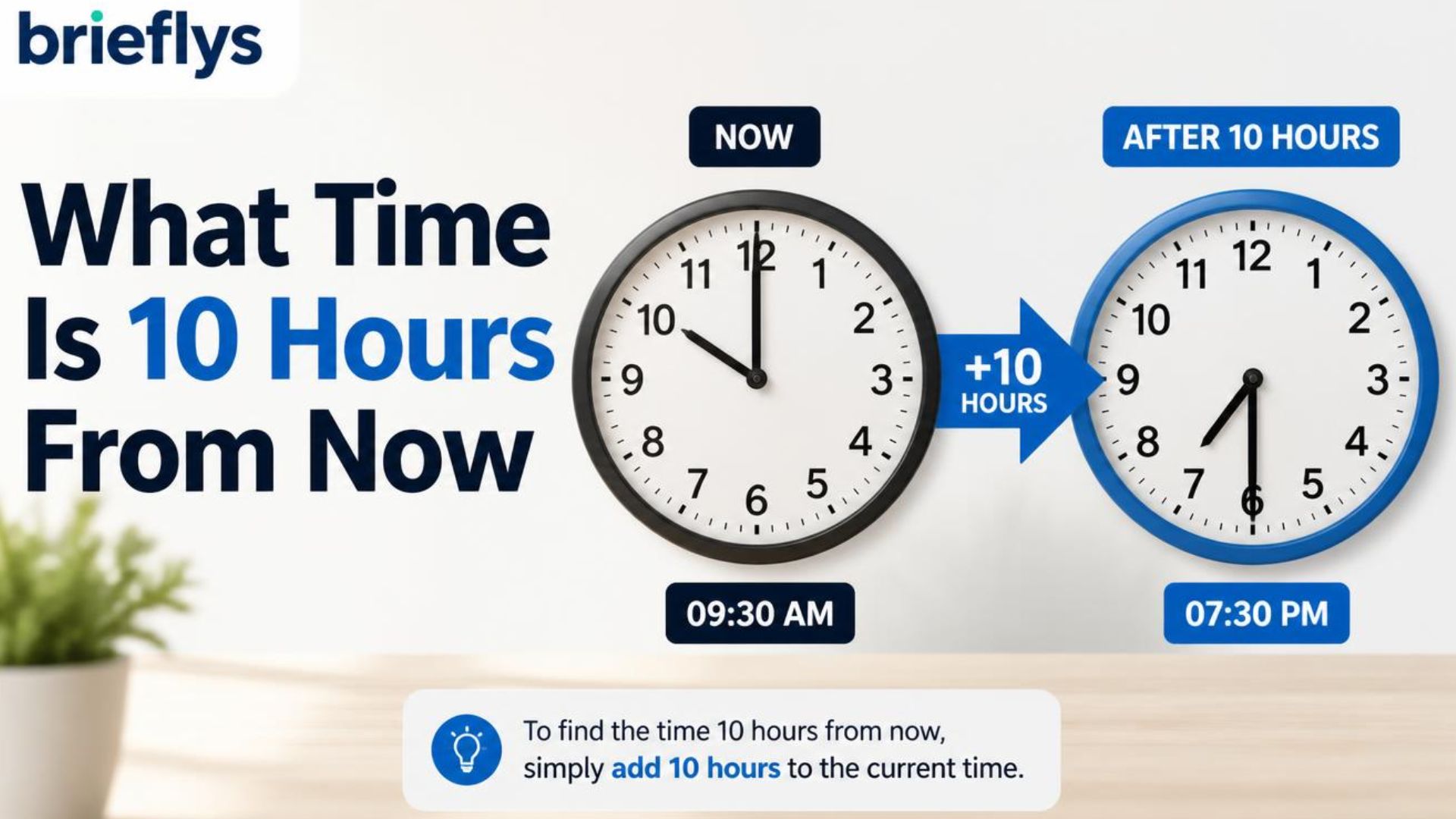
Knowing what time is 10 hours from now can help you plan appointments, organize work, schedule meals, calculate deadlines, and manage your daily routine. If you’re wondering What Time Is 10 Hours From Now, you can calculate the exact future time by adding 10 hours to the current time in your time zone. Answers depend on your present time and location.
For instance, if it is 8:00 AM now, what time is 10 hours from now? It would be 6:00 PM on the same day. Similarly, if it is 8:00 PM, 10 hours later would be 6:00 AM the next day. These simple examples make it easier to calculate future times and plan your schedule accurately.
Determining a future time will be easy if you know how to add hours, tell the difference between AM and PM, and consider the change of date.This guide explains the calculation with practical examples, an hourly breakdown, useful facts, and multiple-choice questions.
What Does “10 Hours From Now” Mean?
“10 hours from now” means the time reached after 10 hours have elapsed from the present moment. Calculation of this is done by first establishing your local time and adding 10 hours to it.
For example:
- If the time is 7 AM, 10 hours later it will be 5 PM.
- If it is 11:00 AM, then 10 hours later it will be 9:00 PM.
- At 4:00 PM, adding 10 hours will result in 2:00 AM the following day.
- When the time is 11:00 PM, in 10 hours, the time will be 9:00 AM the following day.
The calculation measures elapsed time rather than counting the current hour as the first hour. You add a full 10 hours to the starting time.
What Time Will It Be 10 Hours From Now?
The exact answer depends on the current time where you are. Add 10 hours to your local clock reading to find the future time.
For a current example, at approximately 12:04 PM on October 14, 2026, in the UTC+05:00 time zone, 10 hours later is approximately 10:04 PM on October 14, 2026.
These examples assume ordinary clock arithmetic without a daylight saving time transition. If you need the exact time for a real appointment or deadline, use your current clock and the relevant local time zone.
How Many Minutes and Seconds in 10 Hours?
Ten hours equals 600 minutes or 36,000 seconds. These conversions follow the standard relationships of 60 minutes per hour and 60 seconds per minute, as documented by the National Institute of Standards and Technology (NIST).
The calculations are:
- Hours to minutes: 10 × 60 = 600 minutes.
- Minutes to seconds: 600 × 60 = 36,000 seconds.
- Hours to seconds directly: 10 × 3,600 = 36,000 seconds.
This means that a 10-hour work shift, travel period, or waiting period contains 600 minutes of elapsed time. Breaks or interruptions do not change the conversion, although they may affect how much time you spend actively working.
How Can You Calculate 10 Hours From Now Manually?
You don’t require a calculator to calculate the future time. You can add 10 hours in your mind or you can verify your answer through a clock.
A Simple Step-by-Step Method for Adding 10 Hours
Follow these steps:
- Check the current timeDetermine the time of day and specify AM or PM.
- Add 10 to the hour. For example, 7 + 10 = 17.
- Convert to a 12-hour clock if necessary. The 24-hour time 17:00 is 5:00 PM.
- Check whether midnight has passed. If the calculation crosses midnight, the result falls on the next calendar day.
- Keep the minutes unchanged. Adding exactly 10 hours to 7:25 AM gives 5:25 PM, assuming no clock change occurs.
- For calculations involving a 24-hour clock, simply add 10 to the hour number. If the result is 24 or greater, subtract 24 and advance the date by one day.
Examples of Calculating 10 Hours From Different Starting Times
Suppose the current time is 2:30 PM.
- Add 10 hours to 2:30 PM.
- The result is 12:30 AM.
- Because midnight has passed, the result is on the following calendar day.
Now suppose the current time is 5:45 AM. Adding 10 hours gives 3:45 PM on the same day.
These examples demonstrate that the minutes remain the same when adding a whole number of hours. The hour and calendar date are the parts that may change.
Will It Be AM or PM 10 Hours From Now?

Whether the future time is AM or PM depends on the starting time. AM generally covers midnight up to noon, while PM covers noon up to midnight.
Adding 10 hours often changes AM to PM or PM to AM, but crossing noon or midnight determines exactly when the change happens.
How Adding 10 Hours Changes AM to PM or PM to AM
Examples of AM and PM Time Conversions
- If it is 9:15 AM, adding 10 hours gives 7:15 PM on the same day.
- If it is 9:15 PM, adding 10 hours gives 7:15 AM the following day.
- Notice that the minutes remain at 15 in both examples. The difference is whether the calculation crosses midnight.
What Time Will It Be From 1 to 10 Hours From Now?
The table below shows how to calculate future times for a starting point of 8:00 AM. Use it as a reference to understand how each additional hour changes the result.
To change the beginning time, use the same procedure but include the correct number of hours. If the computation passes midnight, carry on to the following date.
Will It Be Tomorrow 10 Hours From Now?
- Not necessarily. Ten hours from now can fall on the same day or the following day, depending on the starting time.
- At 8:00 AM, 10 hours later would be 6:00 PM on the same day. At 8:00 PM, 10 hours later would be 6:00 AM the next day.
- For ordinary clock calculations, the key dividing point is 2:00 PM:
- Before 2:00 PM: Adding 10 hours generally produces a time on the same calendar day.
- At 2:00 PM: Adding 10 hours reaches midnight at the start of the next day.
- After 2:00 PM: Adding 10 hours generally produces a time on the next calendar day.
This rule assumes standard clock arithmetic without a daylight saving time transition. In places that change clocks seasonally, elapsed time and the displayed local clock time can differ around the transition.
What Is the Difference Between 10 Hours From Now and 10 Hours Ago?
The main difference is the direction in which you count time. Ten hours from now refers to a future point, while 10 hours ago refers to a point in the past.
For instance, in case the current time is 6:00 PM:
- Ten hours from now is 4:00 AM tomorrow.
- Ten hours ago it was 8:00 AM today.
Both calculations use the same 10-hour interval, but one adds time and the other subtracts it.
How to Calculate a Future Time
To find a time 10 hours in the future, add 10 to the current hour and adjust the date if the calculation crosses midnight.
For example, 10:00 AM plus 10 hours equals 8:00 PM on the same day.
How to Calculate a Past Time
To find a time 10 hours in the past, subtract 10 hours from the current time. If the calculation moves before midnight, the result falls on the previous day.
For instance, 4:00 am subtracted by 10 hours is 6:00 pm of the preceding day.
These two methods are useful for checking work schedules, reviewing travel times, and calculating when an event started or will finish.
Why Do People Search for “10 Hours From Now”?
People search for “10 hours from now” because they want a quick answer without manually calculating the time. The query is useful when planning events, setting reminders, or working with deadlines that are measured in hours rather than specific clock times.
Common reasons include:
- Work shifts: Finding the end time of a shift that lasts 10 hours.
- Study schedules: Calculating when a study session or planned break will finish.
- Travel: Estimating an arrival time after a 10-hour journey, subject to the itinerary and interruptions.
- Appointments: Working out a future time for a call, meeting, or reminder.
- Daily routines: Planning meals, exercise, household tasks, or rest periods.
- The calculation itself is simple, but the correct answer depends on the current time and the time zone relevant to the activity.
How Could “10 Hours from Now” be Helpful for Scheduling Your Day?

Knowing a future time can help you organize tasks and establish a practical schedule. Once you know when a 10-hour interval ends, you can work backward or forward to fit other activities around it.
Planning Work, Study, and Sleep Schedules
If your work shift begins at 7:00 AM and lasts 10 hours, it ends at 5:00 PM, assuming the shift duration is measured as 10 elapsed hours.
For studying, starting at 9:00 AM and setting a 10-hour overall study period would bring you to 7:00 PM. If you take breaks, remember that the total elapsed period includes those breaks unless you are specifically calculating active study time.
Sleep planning also benefits from time arithmetic. For example, a 10-hour interval beginning at 10:00 PM ends at 8:00 AM the next day. This describes the duration, not a recommendation for how much sleep someone needs.
Calculating Deadlines, Appointments, and Reminders
Suppose you receive a task at 11:30 AM that is due in 10 hours. Adding 10 hours gives 9:30 PM the same day.
For an appointment scheduled 10 hours from now, check the date as well as the time, especially if the interval crosses midnight. If other people are in different time zones, confirm the intended local time to prevent misunderstandings.
For important deadlines, use the deadline’s specified time zone rather than assuming that your own local clock determines when the task is due.
Does Calculating 10 Hours From Now Account for Time Zones?
A basic calculation of 10 hours from now uses the current time in a particular location. To get the correct local clock time, you need to know which time zone applies and whether any clock adjustment occurs during the interval.
The National Institute of Standards and Technology explains that Coordinated Universal Time (UTC) serves as an internationally agreed time standard, while local time is expressed relative to UTC. Different locations may therefore display different clock times at the same moment.
How Local Time Zones Affect Future Time Calculations
If it is 10:00 AM in one location, 10 hours later is 8:00 PM in that same location under ordinary clock arithmetic. However, another location may show a different time because it has a different UTC offset.
For example, Pakistan uses Pakistan Standard Time (PKT), which is UTC+05:00. When coordinating with someone abroad, calculate the interval in the intended location or convert the result to the recipient’s time zone.
The basic rule is to add 10 elapsed hours to the starting instant and then display the result in the relevant local time zone.
What Happens When Daylight Saving Time Changes?
Some locations move their clocks forward or backward during daylight saving time changes. The U.S. National Institute of Standards and Technology explains that clocks in places observing these changes may skip an hour in spring or repeat an hour in autumn.
This matters because adding 10 elapsed hours across a clock change may not produce the same displayed local hour as simply adding 10 to the clock reading.
For example, a clock change can make a local time jump forward or repeat an hour. If your calculation involves such a transition, use a calendar or time-zone-aware clock to calculate the correct future instant.
Not every country observes daylight saving time, and rules vary by location. Check the applicable local rules when accuracy is important.
What Are Some Interesting Facts About 10 Hours From Now?
Here are several useful facts about a 10-hour interval:
- 600 minutes: Ten hours contains 600 minutes.
- 36,000 seconds: Ten hours contains 36,000 seconds.
- Part of a day: Ten hours is 10/24 of a standard 24-hour day, or approximately 41.67%.
- Same-day result: If the starting time is before 2:00 PM, adding 10 hours normally stays within the same calendar day.
- Next-day result: If the starting time is after 2:00 PM, adding 10 hours normally crosses into the next calendar day.
- Minutes stay unchanged: Adding exactly 10 hours does not change the minute value in ordinary clock arithmetic.
- Time zones matter: The displayed local time depends on the location and its applicable time-zone rules.
- These facts make it easier to calculate a future time mentally and recognize when a result should fall on a different day.
Can You Test Your Knowledge of 10 Hours From Now with These MCQs?
Try these multiple-choice questions to check your understanding of time calculations.
1. How many minutes are there in 10 hours?
A. 100 minutes
B. 300 minutes
C. 600 minutes
D. 1,000 minutes
Correct answer: C. 600 minutes
2. What time is 10 hours after 8:00 AM?
A. 4:00 PM
B. 5:00 PM
C. 6:00 PM
D. 8:00 PM
Correct answer: C. 6:00 PM
3. What time is 10 hours after 8:00 PM?
A. 4:00 AM the next day
B. 6:00 AM the next day
C. 8:00 AM the next day
D. 6:00 PM the next day
Correct answer: B. 6:00 AM the next day
4. How many seconds are in 10 hours?
A. 3,600 seconds
B. 10,000 seconds
C. 36,000 seconds
D. 60,000 seconds
Correct answer: C. 36,000 seconds
5. If it is 3:30 PM, what time will it be 10 hours later?
A. 11:30 PM the same day
B. 1:30 AM the next day
C. 3:30 AM the next day
D. 1:30 PM the next day
Correct answer: B. 1:30 AM the next day
6. Which factor is important when calculating a future local clock time across a daylight saving time change?
A. The current month alone
B. The number of minutes in an hour
C. The applicable time-zone rules
D. The name of the calendar month
Correct answer: C. The applicable time-zone rules
Summary
Ten hours from now means adding 10 hours to the current moment. The calculation is straightforward: 10 hours equals 600 minutes or 36,000 seconds.
The final clock time depends on when you start. Adding 10 hours to a morning time usually produces an evening time on the same day, while adding 10 hours to a late-afternoon or evening time generally takes you into the following day.
For everyday planning, mental arithmetic is often enough. For international appointments, important deadlines, or calculations across daylight saving time changes, check the relevant time zone and date to ensure the result is accurate.