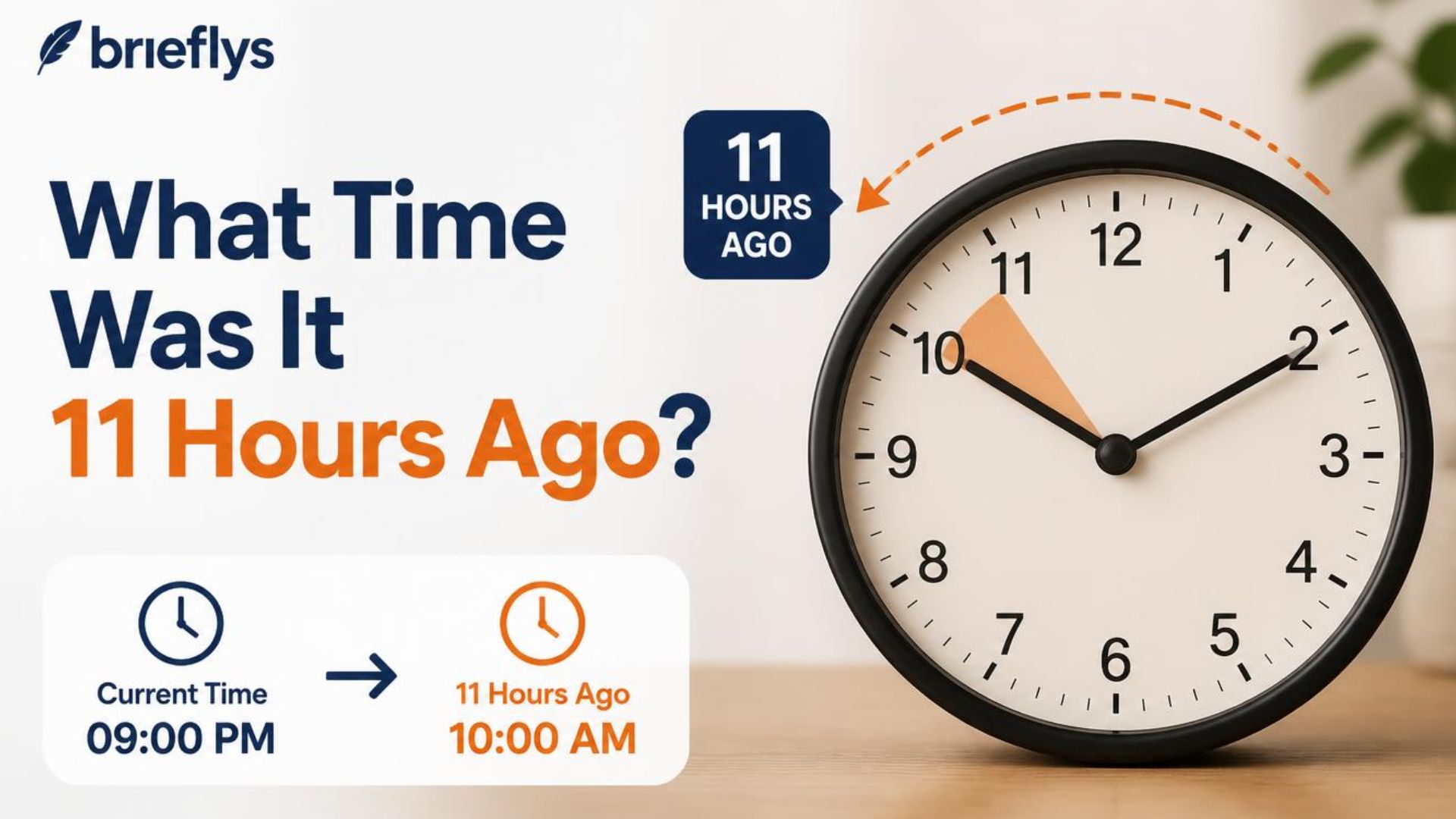
introduction
The question “What time was it 11 hours ago?” prompts you to find the time after deducting 11 hours from the present time. The problem is easy but depends on the time when it started and whether it passes midnight.
For instance, when the time right now is 7 PM, eleven hours back in time would be 8 AM.. However, if the current time is 6:00 AM, 11 hours earlier it was 7:00 PM on the previous day.
You can calculate the result mentally, use a clock, or enter the current date and time into an online calculator. The important thing is to distinguish the number of hours elapsed from the date on which the earlier time occurred.
This guide explains how to calculate 11 hours ago, understand AM and PM, handle midnight, and use practical examples to find accurate answers.
What Time Was It 12 Hours Ago?
Calculating 12 hours ago is slightly different from calculating 11 hours ago. On an ordinary day without a clock change, subtracting 12 hours from a time usually produces the same clock time with the opposite AM/PM designation.
For example:
- 8:00 AM minus 12 hours = 8:00 PM the previous day.
- 8:00 PM minus 12 hours = 8:00 AM the same day.
- 12:00 PM minus 12 hours = 12:00 AM, or midnight, on the same day.
- 12:00 AM minus 12 hours = 12:00 PM, or noon, on the previous day.
These examples assume ordinary local clock arithmetic without a daylight-saving transition.
How Do You Calculate the Time 12 Hours Earlier?
Subtract 12 from the hour according to the 24-hour system. If the outcome is less than zero, add 24 and go back to the previous day.
For example, 20:00 minus 12 hours equals 08:00. Similarly, 05:00 minus 12 hours equals 17:00 on the previous day.
Difference Between AM and PM
AM identifies times before noon, and PM identifies times after noon. The National Institute of Standards and Technology (NIST) notes that noon and midnight can be ambiguous when labeled 12 AM or 12 PM, so writing “noon” or “midnight” is often clearer.
For precise scheduling, especially when the date matters, use an unambiguous time such as 11:59 PM or 12:01 AM.
What Happens to AM and PM When Twelve Hours Are Subtracted?
Subtracting 12 hours usually switches AM to PM or PM to AM while retaining the same displayed hour. Subtracting 11 hours requires moving the clock one hour backward from that result.
For example, 6:00 AM minus 12 hours is 6:00 PM yesterday. Subtracting one more hour gives 5:00 PM yesterday, which is the correct answer for 11 hours ago.
What Time Was It 12 Hours Ago at 8 AM?
If it is 8:00 AM now, 12 hours ago it was 8:00 PM the previous day. To find 11 hours ago instead, add one hour to that earlier result: it was 9:00 PM yesterday.
What Time Was It 12 Hours Ago at 8 PM?
If it is currently 8:00 PM, then twelve hours ago, it would have been 8:00 AM. If eleven hours ago, it would have been 9:00 AM.
This demonstrates why it is so crucial to have the correct number of hours mentioned in the question.
What Causes People to Search for “What Was 12 Hours Ago From Now?”
People often search for past-time calculations when they need to determine when an event occurred. The same need applies to searches for “what time was it 11 hours ago?”
A person might want to check when a message was sent, calculate the beginning of a work shift, estimate when a task started, or understand the time difference between two activities.
The phrase “from now” means that the calculation begins with the current time rather than a fixed time supplied in advance. As a result, the answer changes as the clock moves forward.
What Are the Most Common Reasons for This Search?
Common practical reasons include checking message timestamps, reviewing work schedules, calculating elapsed time, and tracking routine activities. Someone might also use the calculation to estimate when a recording began or when a particular event took place.
The calculation itself does not confirm when an event actually happened. It only identifies the time that falls exactly 11 or 12 hours before the chosen starting point.
Why is It Important to Know the Time 12 Hours Back?
Knowing a past time helps people organize schedules, compare activities, and understand timestamps. It can also be useful when coordinating with people in other locations, provided everyone accounts for the correct time zone.
When a record needs an exact date and time, use the timestamp and its time zone rather than relying only on a mental calculation.
How Does Time Zones Influence Calculation of Historical Time?

Time zones matter when you are calculating a past time in a different location or comparing timestamps from separate regions. Coordinated Universal Time (UTC) provides an internationally agreed reference, while local times are expressed as offsets from UTC.
According to NIST, local time-zone offsets can change when daylight-saving rules apply. Consequently, a calculation involving a clock change may not match simple local-clock subtraction.
For example, if a system records an event in UTC but you read it in local time, you must apply the relevant local offset to interpret the timestamp correctly.
Does Your Time Zone Change the Result?
For a straightforward calculation on the same local clock, subtracting 11 hours gives the same local clock result regardless of your time zone. However, the corresponding UTC time and the date in another location may differ.
For example, 7:00 PM in one time zone does not necessarily correspond to 7:00 PM in another. If you are comparing international events, identify the time zone of each timestamp before calculating the difference.
How Do Daylight-Saving Time Changes Affect Time Calculations?
In regions that observe daylight saving time, clocks may move forward or backward according to local rules. This can make elapsed-time calculations different from calculations based solely on the displayed local clock.
If the goal is to find the instant exactly 11 hours earlier, calculate using a consistent timeline such as UTC and then convert the result to the relevant local time. If the goal is to subtract 11 from the displayed local clock, state that you are performing local-clock arithmetic instead.
Pakistan uses Pakistan Standard Time, UTC+05:00, and does not currently observe seasonal daylight-saving changes. However, the applicable time rules should always be checked for the location and date involved.
How Can You Use Online Time Calculators to Find Past Times?
Online time calculators can reduce mistakes when you need to subtract hours, minutes, or seconds or when the calculation crosses a date boundary.
The Date and Time Calculator provided by timeanddate.com allows users to enter a starting date and time, choose whether to add or subtract, and specify time units. It then calculates the resulting date and time.
To use a calculator for an 11-hour subtraction:
- Enter the starting date and current local time.
- Select the subtraction option.
- Enter 11 in the hours field.
- Calculate the result.
- Check the resulting date and time zone.
How Do Online Time Calculators Work?
A date-and-time calculator applies arithmetic to the starting date and time, taking account of the units and calendar information used by the tool. Some calculators may also take into consideration the time zone settings.
For a simple calculation such as 7:00 PM minus 11 hours, mental arithmetic is usually enough. A calculator becomes more useful when the starting point includes a specific date, seconds, multiple time units, or a daylight-saving transition.
When Should You Use a Time Calculator Instead of Calculating Manually?
Use manual calculation for ordinary situations where only the hour matters. Choose a calculator when precision is important, the date is uncertain, the calculation involves multiple time units, or the starting and ending locations use different time zones.
For official records, work logs, or system timestamps, verify the time zone and date rather than relying solely on a displayed clock value.
How Does Human Perception of Time Affect Our Understanding of the Past?
People do not always remember the passage of time accurately. An hour spent waiting can feel longer than an hour spent doing something engaging, even though both periods have the same duration on a clock.
This subjective experience can make it difficult to estimate when an event happened. A person may remember that something occurred “about half a day ago” without knowing whether 11 or 12 hours have passed.
A clock-based calculation provides an objective reference that helps distinguish remembered duration from measured time.
Why Can Twelve Hours Feel Longer or Shorter?
Attention, activity, waiting, and memory can influence how long a period seems. A busy day may feel short in retrospect, while a stressful or uneventful period may seem much longer.
These impressions are subjective and should not replace a timestamp when an exact time is required.
How Does Memory Influence Our Perception of Time?
Memory often organizes events by sequence and context rather than by precise clock time. One may recall events which occurred before and after the event but forget the exact time.
The time at which an incident took place can be determined through the checking of the date of a particular message or an appointment in a calendar.
How Can You Apply the Formula to Any Starting Time?
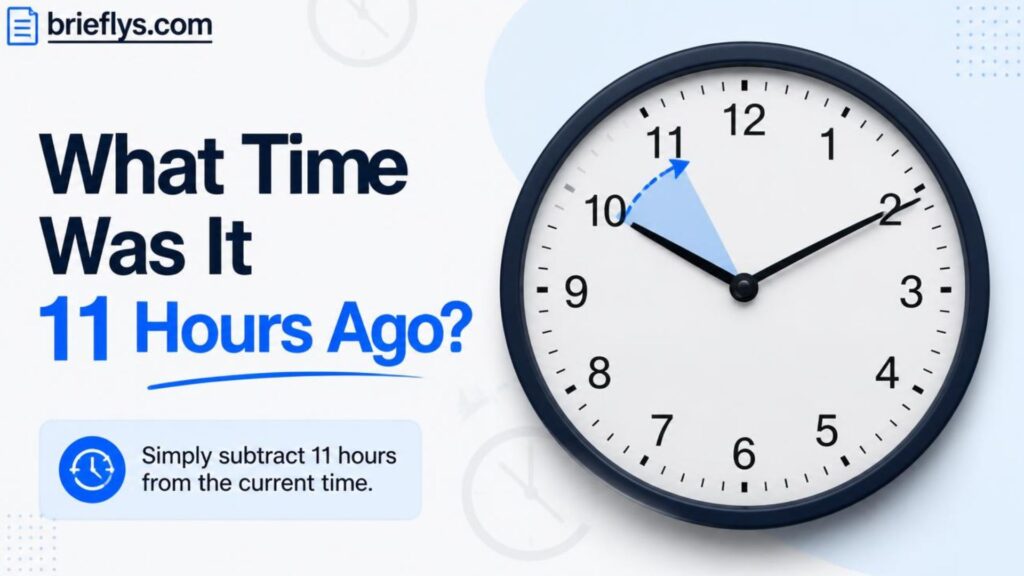
Substitute the old hour with the start hour and substitute the subtraction number with the new interval. If minutes or seconds are also involved, convert the full time into a consistent unit, perform the subtraction, and convert it back.
For example, 18:30 minus 11 hours equals 07:30 on the same day. The minutes stay the same because the number of hours that get subtracted is exactly 11.
What Time Was It 12 Hours Before 6 AM?
If it is 6:00 AM now, 12 hours earlier it was 6:00 PM yesterday. For comparison, 11 hours earlier it was 7:00 PM yesterday.
What Time Was It 12 Hours Before 10 PM?
If it is 10:00 PM now, 12 hours earlier it was 10:00 AM today. Eleven hours earlier it was 11:00 AM today.
Remembering these two examples can help you check your arithmetic when a question uses a different number of hours.
What About Seconds and Milliseconds When Calculating Time?
Hours are often sufficient for everyday calculations, but some situations require minutes, seconds, or milliseconds. A millisecond is one-thousandth of a second, so 1,000 milliseconds equal one second.
If you are calculating exactly 11 hours earlier, subtract 11 hours while retaining the minutes, seconds, and fractional seconds, provided no time-scale transition affects the interpretation.
For example, 18:25:40 minus 11 hours equals 07:25:40 on the same day.
How Do Seconds and Milliseconds Affect Time Calculations?
Subtracting a whole number of hours does not change the minute, second, or millisecond values in ordinary arithmetic. Subtracting a non-whole-hour interval may require borrowing from the next larger unit.
For example, subtracting 90 seconds from 12:00:30 gives 11:59:00. The calculation first moves backward by one minute and 30 seconds.
When Do You Need More Precise Time Measurements?
Accuracy becomes more important while examining the logs of computers, analyzing recorded activities, evaluating technological processes, and comparing time stamps of different systems.
NIST explains that accurate timekeeping relies on defined time standards and carefully maintained clocks. For everyday questions, a normal clock is generally enough; for technical work, use a trusted timestamp and identify its time standard.
Why Does Time Sometimes Feel Different From What the Clock Shows?
The clock measures time consistently for ordinary daily purposes, but our experience of duration varies. An enjoyable activity can seem to pass quickly, while waiting for an appointment can feel slow.
This difference between measured time and perceived time explains why estimating a past event from memory may be less reliable than checking a timestamp.
What Makes Time Seem to Pass Quickly or Slowly?
The amount of attention given to an activity, the presence of distractions, and the nature of the experience can affect how long a period seems to last.
These perceptions relate to the subjective experience and not an increase in the number of hours that have passed.
How Does Routine Influence Our Sense of Time?
Repeated daily activities can blend together in memory, making it difficult to identify the precise time an event occurred. Keeping a schedule, recording timestamps, or checking a digital history can help establish a clearer timeline.
What Tips Can Help You Calculate Time Faster?
You can speed up time calculations by using a consistent method instead of trying to remember every possible AM/PM combination.
First, convert the current hour to a 24-hour format. Then subtract the number of hours and adjust the date if the result crosses midnight. Finally, convert the answer into the format you prefer.
How Can You Calculate Eleven Hours Backward Mentally?
This would be easy if we were to deduct twelve hours first before adding another hour.
For example, if the current time is 9:00 PM:
- Twelve hours earlier: 9:00 AM.
- Add one hour: 10:00 AM.
- Therefore, 11 hours ago was 10:00 AM today.
- If the current time is 5:00 AM:
- Twelve hours earlier: 5:00 PM yesterday.
- Add one hour: 6:00 PM yesterday.
- Therefore, 11 hours ago was 6:00 PM yesterday.
What Shortcuts Make Time Calculations Easier?
Keep these three rules in mind:
- Subtract 12 hours to switch between the two halves of the day.
- Add one hour to the 12-hours-ago result to find 11 hours ago.
- Check the date whenever the calculation crosses midnight.
- In case of complex calculations, a 24-hour clock or an online date and time calculator can be used.
What Interesting Facts Should You Know About Time Calculations?
Here are several useful facts about time and clocks:
- A standard day contains 24 hours.
- There are 60 minutes in an hour and 60 seconds in a minute.
- The 12-hour clock uses AM and PM to distinguish the two halves of the day.
- The 24-hour clock represents midnight at 00:00 and noon at 12:00.
- UTC is an internationally agreed time standard used to coordinate timekeeping.
- Local time-zone offsets can differ, and some regions change their clocks seasonally.
- A whole-hour subtraction ordinarily preserves the minute and second values.
- Crossing midnight during a backward calculation usually changes the calendar date to the previous day.
- NIST’s timekeeping resources explain the distinctions between local time, UTC, the 12-hour clock, and the 24-hour clock.
What Multiple-Choice Questions Can Test Your Understanding of Time Calculations?
Test your knowledge with these multiple-choice questions.
1. If the current time is 7:00 PM, what time was it 11 hours ago?
A. 5:00 AM
B. 6:00 AM
C. 8:00 AM
D. 9:00 AM
Correct answer: C. 8:00 AM.
2. If it is 4:00 AM now, what time was it 11 hours earlier?
A. 3:00 PM yesterday
B. 4:00 PM yesterday
C. 5:00 PM yesterday
D. 7:00 PM yesterday
Correct answer: C. 5:00 PM yesterday.
3. What time was it 12 hours ago if the current time is 9:00 PM?
A. 9:00 AM today
B. 10:00 AM today
C. 9:00 AM yesterday
D. 8:00 AM today
Correct answer: A. 9:00 AM today.
4. How many minutes are in 11 hours?
A. 550
B. 600
C. 660
D. 720
Correct answer: C. 660 minutes.
5. Which clock format helps avoid confusion between AM and PM?
A. 6-hour clock
B. 12-hour clock
C. 24-hour clock
D. 60-hour clock
Correct answer: C. 24-hour clock.
Summary
Finding out what time it was 11 hours ago is a straightforward calculation: subtract 11 hours from the current time, then check whether the result belongs to the previous day.
The simplest mental shortcut is to subtract 12 hours and add one hour back. For example, if it is 7:00 PM now, 12 hours earlier was 7:00 AM, so 11 hours earlier was 8:00 AM.
For reliable results, distinguish 11-hour calculations from 12-hour calculations, use the 24-hour clock when AM and PM become confusing, and check the date whenever the calculation crosses midnight. If the calculation involves different time zones or a daylight-saving transition, use the relevant time-zone rules or a date-and-time calculator.
The main rule is simple: subtract 11 hours, verify the date, and confirm the time zone when precision matters.