introduction
The question “What time was it 16 hours ago?” asks you to work backward from a specific time to find the time exactly 16 hours earlier. You can solve it by subtracting 16 hours from the current time or from any time you choose.
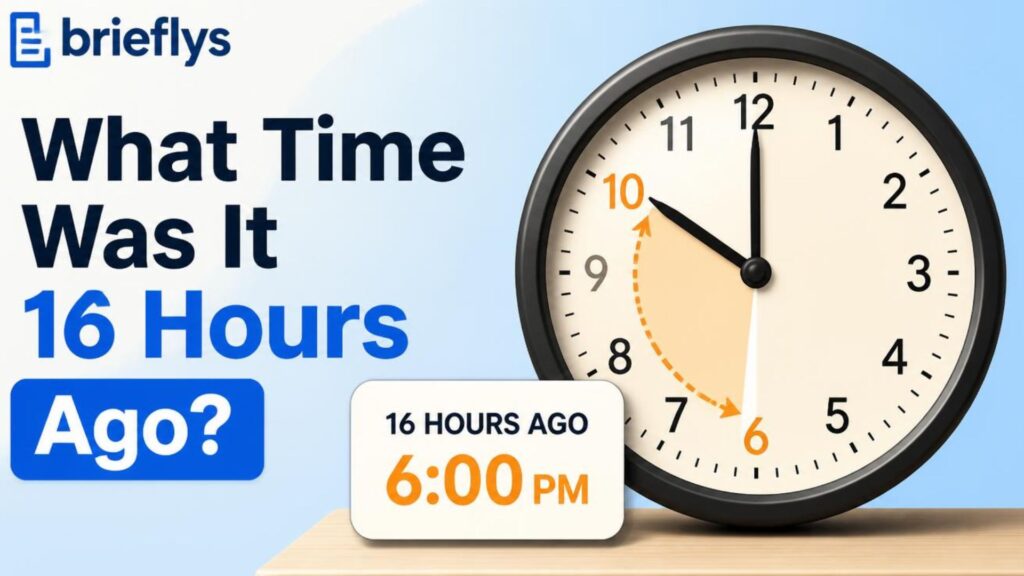
For example, if it is 10:00 PM now, 16 hours earlier was 6:00 AM on the same day. However, if it is 8:00 AM now, 16 hours earlier was 4:00 PM on the previous day.
The calculation becomes easier when you remember that a full day contains 24 hours. Subtracting 16 hours is equivalent to subtracting 12 hours and then another 4 hours. If the calculation crosses midnight, the date must change as well.
Why Do People Search for “What Time Was It 16 Hours Ago”?
People search for this question when they need to work out an earlier time without calculating it mentally. The answer can help with planning, checking schedules, reviewing events, and understanding when something happened.
What Are the Common Reasons for Calculating 16 Hours Ago?
Common reasons include:
- Checking messages: Working out approximately when a message was sent or received.
- Reviewing work schedules: Identifying when a shift, task, or meeting began.
- Tracking activities: Estimating when an exercise session, trip, or other activity took place.
- Planning routines: Comparing sleep, study, work, or meal schedules.
- Reviewing records: Finding a likely time for an event when only the current time and elapsed hours are known.
- A 16-hour calculation gives a precise result when the starting time is known and the calculation uses the same time standard throughout.
How Can This Calculation Help in Daily Life?
Suppose you see a notification saying an activity happened 16 hours ago. Knowing the current time lets you estimate the activity’s clock time. If you need to establish exactly when an event occurred, however, use the original timestamp and date rather than relying on a rough estimate or memory.
How Can You Calculate What Time It Was 16 Hours Ago?
The simplest method is to subtract 16 from the current hour. If the result falls below zero on a 24-hour clock, add 24 and move back one calendar day.
Basic formula:
Earlier time = Starting time − 16 hours
For example, if the starting time is 22:00, subtracting 16 gives 06:00. The result is 6:00 AM on the same calendar day.
How Can You Calculate 16 Hours Ago Without a Calculator?
You can split the calculation into two smaller steps:
Subtract 12 hours.
Subtract another 4 hours.
For example, if it is 9:00 PM:
- 9:00 PM minus 12 hours = 9:00 AM.
- 9:00 AM minus 4 hours = 5:00 AM.
Therefore, 16 hours before 9:00 PM was 5:00 AM that same day.
This method is useful because subtracting 12 hours switches between AM and PM while keeping the same clock hour, except where midnight or noon is involved. Subtracting the remaining 4 hours completes the calculation.
How Does Clock Arithmetic Help You Calculate Time?
Clock arithmetic uses the repeating 24-hour cycle of a day. After 23:59, the clock advances to 00:00 on the next day. When you calculate backward past midnight, you move to the previous date.
How Do You Subtract Hours on a 24-Hour Clock?
The 24-hour clock represents times from 00:00 through 23:59. To calculate 16 hours earlier, subtract 16 from the hour number while keeping the minutes unchanged.
For example:
- Starting time: 20:30
- Subtract 16 hours: 20 − 16 = 4
- Result: 04:30
- So, 16 hours before 8:30 PM is 4:30 AM on the same day.
What Happens When You Cross the Midnight Boundary?
Crossing midnight means that the calculation moves from one calendar date to another. The clock time alone may not tell the whole story, so the date should be checked whenever the result falls on the previous day.
How Can You Avoid Confusion Between Today and Yesterday?
Write down both the time and the date before performing the calculation. After subtracting 16 hours, confirm whether midnight was crossed.
For instance, if it is Tuesday at 7:00 AM, 16 hours earlier was Monday at 3:00 PM. Recording the weekday alongside the clock time prevents the result from being mistaken for Tuesday afternoon.
How Does the 12-Hour Clock Compare With the 24-Hour Time System?
The 12-hour clock uses AM and PM to distinguish the two halves of a day. The 24-hour clock uses hour numbers from 00 to 23, making it easier to perform calculations without switching between AM and PM labels.
How Do AM and PM Affect a 16-Hour Calculation?
In the 12-hour system, AM refers to the period before noon and PM to the period from noon until midnight. Midnight is 12:00 AM, while noon is 12:00 PM.
For example, 16 hours before 6:00 PM is 2:00 AM on the same day. In 24-hour notation, this is 18:00 minus 16 hours, which equals 02:00.
Why Is the 24-Hour Clock Useful for Time Calculations?
The 24-hour format reduces ambiguity because each hour has a unique number. It is particularly convenient for schedules, transport timetables, digital records, and calculations that cross midnight.
For changing normal time to 24-hour clock, we have to add 12 to the hours when it is past noon and keep midnight as 00:00.. Noon remains 12:00.
What Happens Inside a Time Difference Calculator?
A date-and-time calculator takes a starting date and time, applies the requested number of hours or other time units, and displays the resulting date and time.
The timeanddate.com guide, “How to Use: Date and Time Calculator,” explains that users can enter a starting date and time, choose whether to add or subtract units, and calculate a new result.
When Should You Use an Online Time Calculator?
An online calculator is especially useful when you need to account for a specific date, calculate several time intervals, or work with different time zones. For a simple same-day calculation, manual subtraction is usually sufficient.
One important limitation: timeanddate.com states that its Date and Time Calculator does not account for daylight-saving-time changes or leap seconds. IIf your calculation uses a time zone change or a very accurate timestamp, you should use a specialized tool.
Why Do Local Time and Time Zones Matter More Than You Think?
A clock time depends on the time zone in which it is displayed. If you are calculating 16 hours ago using a local clock, use the relevant location’s time and date. If an event happened elsewhere, its original time zone may also be important.
How Can Time Zones Affect the Answer?
Suppose someone sends a message from another country. The message might be displayed in your local time even though the sender’s clock shows a different hour. The elapsed interval can still be 16 hours, but the displayed clock times may differ.
For accurate comparisons between locations, record the date, time, and time zone. Coordinated Universal Time (UTC) is a common reference for expressing timestamps consistently across locations.
Can Daylight Saving Time Change a 16-Hour Calculation?
Yes. In regions that practice daylight savings, the clocks can be advanced or even reverted to their previous settings.serve daylight saving time, clocks may move forward or backward during a scheduled transition. This can make the difference between two local clock readings different from the actual elapsed time.
The National Institute of Standards and Technology (NIST), in its “Local Time FAQs,” explains how standard time, daylight time, and local time designations are used. For a straightforward calculation on a day without a clock change, ordinary subtraction works. For a calculation that crosses a daylight-saving transition, use the date, location, and time zone to determine the correct result.
Why Doesn’t Human Memory Work Like a Clock?
People can remember the general order of events without remembering their exact clock times. Someone may recall having lunch before a meeting but be unsure whether lunch started at noon or 1:00 PM.
Research on time perception and memory explores how attention, experience, and the way events are remembered affect judgments of duration and timing. A review by Richard A. Block and Ronald P. Gruber, indexed by PubMed as “Time perception, attention, and memory: a selective review,” discusses differences between experienced duration and remembered duration.
Why Can It Be Difficult to Remember an Exact Time?
Daily routines often contain similar events, which can make their exact timing difficult to distinguish later. Remembering that something happened in the morning is not the same as knowing the precise time it occurred.
When accuracy matters, use a timestamp, calendar entry, receipt, message history, or other dated record rather than relying entirely on memory.
How Can Timestamps Help You Reconstruct the Past?
A timestamp provides a recorded date or time associated with an event. For example, a message history may show when a message was sent, while a calendar entry can help confirm when a meeting was scheduled.
These records can help establish a timeline, but remember that a displayed timestamp may use a particular time zone or device setting. Check those details when comparing records from different sources.
How Can You Reconstruct a Timeline in Everyday Life?
A timeline organizes events in chronological order. To reconstruct one, start with the most reliable recorded time, calculate backward or forward as needed, and compare the result with other records.
How Can Messages and Records Help Establish an Event Time?
Suppose you are reviewing a message received at 9:00 AM and want to know when an event occurred 16 hours earlierSubtracting 16 hours would give 5:00 PM of the previous day.
If another record gives a different time, check whether it refers to the same event and time zone. The discrepancy may come from a different starting point, a date change, or the way a system displays timestamps.
Why Is the Date Just as Important as the Clock Time?
A time such as 5:00 PM can occur on any date. Without the date, it may be impossible to determine which event or record is relevant.
For workplace records, travel plans, appointments, and message histories, keeping the date attached to the time makes the timeline clearer and more reliable.
The Psychology Behind the Perception of Time
Clock time and subjective time are similar, yet distinct.. A clock measures time using a standardized system, while a person’s experience of how long something lasted can depend on attention and memory.
The academic review “Temporal cognition: Connecting subjective time to perception, attention, and memory,” by William J. Matthews and Warren H. Meck, examines links between subjective duration, attention, perception, and past experience.
Why Can 16 Hours Feel Shorter or Longer Than They Really Are?
A busy day may seem to pass quickly, while a period spent waiting can feel long. These impressions do not alter the quantity of hours on the clock; rather, they represent subjective assessments of time passed.
Consequently, feeling that an event happened recently does not establish that it occurred within the last 16 hours. A clock or timestamp is more appropriate when an exact interval is needed.
How Do Attention and Memory Influence Time Judgments?
Attention affects what people notice while an event is happening, and memory influences how they later describe or estimate that event. Research examines these processes as factors in judgments about time, rather than treating subjective impressions as exact measurements.
For everyday calculations, it is useful to separate the question “How long did it feel?” from “What time was it 16 hours ago?”
How Does Technology Make Time Calculations Easier?
Digital clocks, calendars, smartphones, and online calculators make it easier to check times and dates. A calculator can handle the arithmetic, while a calendar or message history can provide the starting timestamp.
How Can Smartphones and Digital Clocks Help?
Most smartphones display the current time and date, and many allow users to view timestamps in messaging applications or calendar events. These features can help identify a starting point before subtracting 16 hours.
However, the result depends on using the correct starting time. If the device displays another time zone or the event occurred during a clock change, check the relevant settings and date.
What Are the Benefits of an Online Time Calculator?
An online date-and-time calculator can apply an interval to a selected starting date and time and display the result. This is useful for repeated calculations or when the result must include the previous calendar day.
For a simple question such as “What time was it 16 hours ago?”, a short mental calculation may be faster. Technology is most helpful when it reduces uncertainty or handles details that are easy to overlook.
In Which Common Situations Might You Need to Calculate 16 Hours Ago?
Calculating 16 hours earlier can be useful whenever you need to connect a current time with an earlier event.
When Might You Need It for Work or Daily Schedules?
You might use the calculation to review a shift, estimate when a task began, or check the timing of a scheduled activity. For formal records, use the recorded start and end times rather than relying only on a calculated estimate.
When Might You Need It to Review Messages or Events?
If a message or notification says an activity occurred 16 hours ago, subtracting 16 hours from the relevant reference time gives the approximate clock time. Check the date as well, particularly when the result falls on the previous day.
If the displayed age is rounded—for example, “16 hours ago”—the original event time may not be exact. Open the original record if you need greater precision.
Is Manual Time Calculation Better Than Using Digital Tools?
Neither method is always better. Manual subtraction is convenient for straightforward problems, while digital tools can help with calculations involving dates, multiple intervals, or time-zone details.
What Are the Advantages of Calculating Manually?
Manual calculation is quick, requires no internet connection, and helps you understand how hours move across midnight. The shortcut of subtracting 12 hours and then 4 more hours is often enough for a 16-hour interval.
When Is a Digital Calculator the Better Choice?
Use a calculator when you need to check a particular date, calculate many intervals, or avoid arithmetic mistakes in an important schedule. For time-zone or daylight-saving questions, select a tool that explicitly supports those requirements.
What Practical Tips Can Help You Calculate Time Accurately?
A few simple habits can make time calculations more reliable:
- Use 24-hour notation: Convert 8:00 PM to 20:00 before subtracting.
- Split the calculation: Subtract 12 hours, then subtract 4 hours.
- Check midnight: If the result crosses midnight, move to the previous date.
- Keep the minutes: Subtracting exactly 16 hours does not change the minute value.
- Write down the date: This prevents confusion between today and yesterday.
- Check the time zone: Do this when comparing records from different locations.
- Use the original timestamp: Prefer recorded data when precision matters.
For ordinary clock arithmetic, these steps are enough. If the calculation crosses a daylight-saving transition, ordinary local-clock subtraction may not equal the actual elapsed duration.
Why Is Understanding Time Important in Everyday Life?
Understanding time helps people organize appointments, coordinate activities, manage schedules, and interpret records. Calculating a past time is a small but useful skill because it connects an interval with a specific point on the clock.
The most important habit is to distinguish the time of day from the date and, when necessary, the time zone. A correct clock time without its corresponding date may not provide the full answer.
What Interesting Facts Should You Know About Time Calculations?
Here are several useful facts:
- Sixteen hours equals 960 minutes. Multiply 16 by 60 to convert hours into minutes.
- Sixteen hours is less than one full day. A standard day contains 24 hours, leaving an eight-hour difference.
- Subtracting 16 hours can change the date. For starting times before 4:00 PM, the result is on the previous calendar day under ordinary clock arithmetic.
- The 24-hour clock simplifies calculations. It represents each hour of the day with a unique number from 00 through 23.
- Elapsed time and displayed local time are not always interchangeable. Time-zone differences and daylight-saving changes can affect how local timestamps compare.
- These facts are useful for quick mental calculations and for understanding when a more detailed date-and-time tool may be necessary.
What Multiple-Choice Questions Can Test Your Knowledge of Time Calculations?
Test your understanding with these questions.
1. What time was it 16 hours before 10:00 PM?
A. 4:00 AM
B. 6:00 AM
C. 8:00 AM
D. 2:00 PM
Correct answer: B. 6:00 AM
2. What time was it 16 hours before 8:00 AM?
A. 4:00 PM the previous day
B. 6:00 PM the previous day
C. 12:00 AM the same day
D. 4:00 AM the same day
Correct answer: A. 4:00 PM the previous day
3. How many minutes are there in 16 hours?
A. 160
B. 600
C. 960
D. 1,600
Correct answer: C. 960
4. Which clock format is often easiest for subtracting hours across midnight?
A. 12-hour clock without AM or PM
B. 24-hour clock
C. A clock without numbers
D. A calendar without times
Correct answer: B. 24-hour clock
5. What should you check when calculating a time interval across different locations?
A. The color of the clock
B. The time zone and date
C. The screen size
D. The order of the weekdays
Correct answer: B. The time zone and date
Summary
To find what time it was 16 hours ago, subtract 16 hours from the starting time. If the result falls before midnight on the previous day, adjust the date accordingly.
For example, 16 hours before 10:00 PM is 6:00 AM on the same day, while 16 hours before 8:00 AM is 4:00 PM on the previous day. You can calculate these examples manually or use a date-and-time calculator.
For the most accurate answer, keep track of the starting date, use a consistent time zone, and check for daylight-saving changes when relevant.