introduction
Thinking about when 2:30 PM will arrive? It all comes down to what time you are at now.. If it is 1:00 PM, you have 1 hour and 30 minutes to wait. If it is 11:45 AM, there are 2 hours and 45 minutes remaining. And if it is already 3:00 PM, that day’s 2:30 PM has passed.
Knowing how much time is left can allow one to organize his/her meetings, schooling, breaks at work, appointments, and many other everyday activities. This can be calculated by hand, through time difference equation, or through a real-time countdown clock.
This guide explains how to calculate the time until 2:30 PM, compare different starting times, and understand the difference between 12-hour and 24-hour time formats.
What Does “How Long Until 2:30 PM” Actually Mean?
The question “How long until 2:30 PM?” asks for the amount of time between the current moment and 2:30 in the afternoon.
The answer changes throughout the day. At 10:00 AM, there are 4 hours and 30 minutes until 2:30 PM. At 2:00 PM, only 30 minutes remain. At 2:29 PM, the wait is just one minute.
If it is already later than 2:30 PM, the target time has passed for that day. If you mean the next occurrence of 2:30 PM, you must calculate the time remaining until tomorrow afternoon.
How Do You Know Whether 2:30 PM Is Still Ahead or Has Already Passed?
Compare the present local time with 2:30 PM.
- Prior to 2:30 p.m.: Determine the number of hours between now and your goal.
- Exactly at 2:30 PM: No time remains; the target time has arrived.
- After 2:30 PM: Today’s target has passed, so the next occurrence is tomorrow at 2:30 PM if you are counting down to the next daily occurrence.
For instance, if the current time is 12:15 p.m., then the time left will be two hours and 15 minutes. If the current time is 4:00 p.m., then 2:30 p.m. of today has already passed by one hour and 30 minutes.
The distinction matters because “time until 2:30 PM today” and “time until the next 2:30 PM” are different questions after the target has passed.
What’s the Difference between 2:30 AM and 2:30 PM?
The main difference lies in the portion of the day each activity symbolizes.
- 2:30 AM: Half past two in the early morning.
- 2:30 PM: Half past two in the afternoon.
- In the 24-hour clock, 2:30 AM is written as 02:30, while 2:30 PM is written as 14:30.
The 24-hour format avoids confusion between morning and afternoon. It is particularly useful for transport schedules, digital systems, travel itineraries, and work timetables.
Why Do People Search “How Long Until 2:30 PM”?
People often want to know how much time remains before a specific event, deadline, appointment, or daily activity. Because 2:30 PM is a precise target, calculating the time remaining can make planning easier.
Someone might be waiting for a school dismissal, an afternoon meeting, a delivery window, or the end of a scheduled task. Another person might simply want to know when to leave home or take a break.
The search itself does not reveal the user’s reason. It is a straightforward time-calculation question that can be answered once the current time and time zone are known.
How Can Knowing the Time Left Help With Daily Plans and Appointments?
Knowing the remaining time helps you divide your schedule into manageable intervals.
For example, if a meeting begins at 2:30 PM and it is currently 1:15 PM, you have 1 hour and 15 minutes. You could use that interval to finish a task, prepare documents, travel, or take a break.
A countdown can also help you avoid last-minute rushing. If travel or preparation is required, calculate the time available before the appointment rather than assuming that the appointment time is the same as the time you need to leave.
When Might You Need a Countdown to 2:30 PM?
A countdown can be useful in several situations:
- Preparing for an afternoon meeting.
- Tracking the time before a class or appointment.
- Planning a lunch break or work task.
- Knowing how long remains before a scheduled call.
- Organizing travel and departure times.
- Setting a personal deadline for completing an activity.
For recurring activities, a calendar reminder or alarm can be more practical than repeatedly checking the countdown. A countdown tells you how much time remains, while a reminder can notify you when the target arrives.
How Can You Calculate the Time Until 2:30 PM?
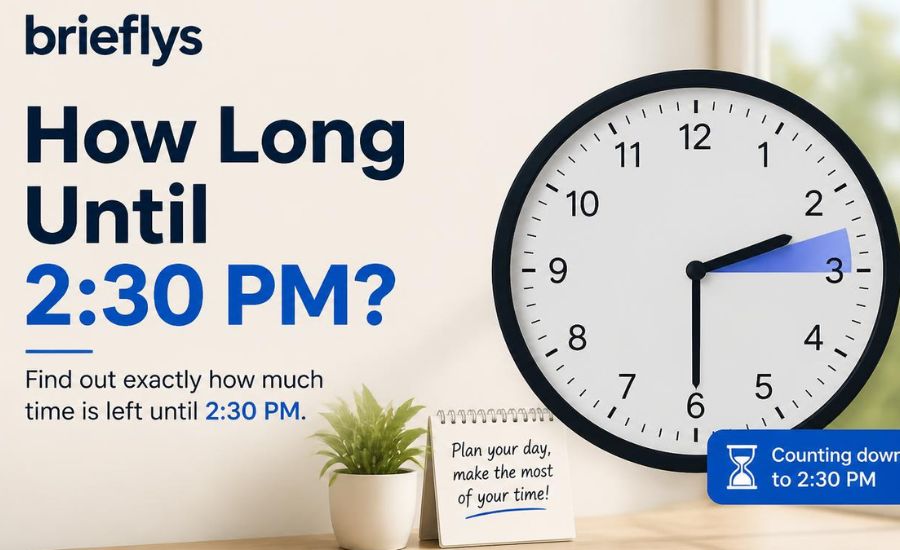
You can calculate the time remaining by subtracting the current time from the target time. The easiest method is to work in hours and minutes, borrowing an hour when the current minute value is greater than the target’s minute value.
For example, suppose the current time is 11:45 AM and the target is 2:30 PM.
From 11:45 AM to 12:00 PM is 15 minutes. From noon to 2:30 PM is another 2 hours and 30 minutes.
The total is 2 hours and 45 minutes.
How Do You Subtract the Current Time From 2:30 PM?
When both times occur on the same day and the current time is earlier than the target, you can subtract them directly.
Example: Current time = 1:10 PM
Target time: 2:30 PM
Current time: 1:10 PM
Subtracting gives:
- Minutes: 30 − 10 = 20 minutes.
- Hours: 2 − 1 = 1 hour.
Time remaining: 1 hour and 20 minutes.
If the current time is 12:10 PM, the same method gives 2 hours and 20 minutes remaining.
How Do You Determine the Time Left When There Are Different Minutes?
Sometimes you need to borrow an hour to subtract the minutes.
Consider a current time of 1:50 PM.
Target: 2:30 PM
Current: 1:50 PM
Since 30 minutes is less than 50 minutes, rewrite 2:30 PM as 1 hour and 90 minutes to solve this problem.
- Minutes: 90 − 50 = 40 minutes.
- Hours: 1 − 1 = 0 hours.
Time remaining: 40 minutes.
Another method is to count forwardBetween 1:50 PM and 2:00 PM is 10 minutes, while between 2:00 PM and 2:30 PM is 30 minutes.. Together, these make 40 minutes.
Forward counting becomes easy when the initial time is near the required time.
How Many Hours to 2:30 PM From Various Times on This Day?
Examples of the time left are provided in the table below, where the present time is before 2:30 PM.
These examples are fixed calculations, not a live countdown.Actual time left would depend on the current time of your location.
What Amount of Time Remains for Various Morning and Afternoon Periods?
Morning: It could be several more hours before 2:30 PM.. For instance, at 9:30 AM, there are exactly five hours until the target.Two hours and 45 minutes still remain until 11:45 AM.
During the early afternoon, the interval becomes shorter. At 1:15 PM, there is 1 hour and 15 minutes remaining. At 2:10 PM, there are only 20 minutes left.
These examples show why checking the current time is essential. The target remains the same, but the amount of time remaining changes with every passing minute.
What Happens if It Is Already Past 2:30 PM?
If the current time is later than 2:30 PM, the day’s target has already passed.
For example, at 3:00 PM, 2:30 PM was 30 minutes ago. If you want to know how long until the next 2:30 PM, the answer is 23 hours and 30 minutes.
At 8:00 PM, the next 2:30 PM is 18 hours and 30 minutes away.
This calculation assumes that you mean the next occurrence of 2:30 PM on the following day and that you are using the same local time zone. For ordinary everyday planning, this is usually sufficient. More complex situations involving time-zone changes or daylight-saving transitions may require date-aware calculations.
Why Is a Live Countdown Timer Better Than Manual Math?
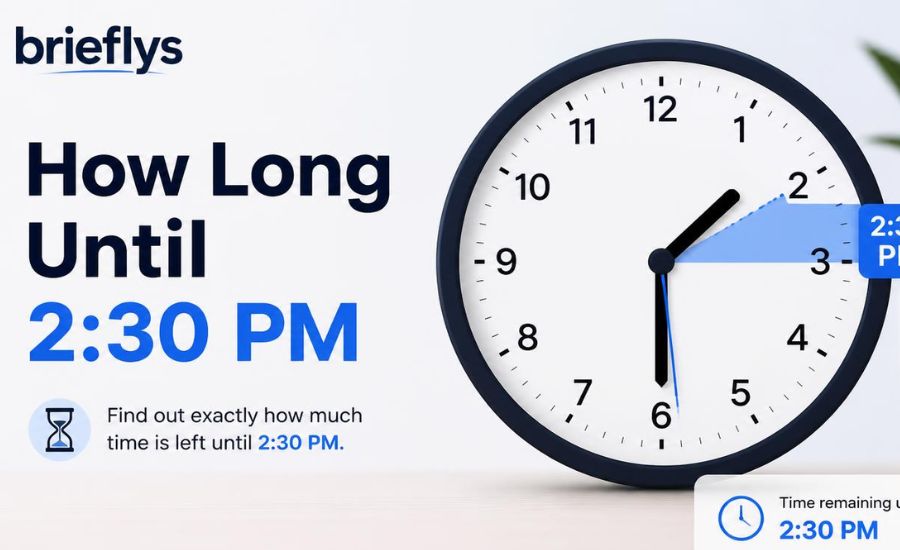
Manual calculations are useful when you need a quick answer, but a live countdown timer can be more convenient when you want to track the seconds as well as the hours and minutes.
A countdown typically compares the current time with a specified target. If it is designed to update continuously, the displayed time remaining changes as time passes.
However, the result depends on the timer’s settings, the device’s clock, and the selected time zone. A countdown is only useful if it is counting toward the correct target.
How Can a Countdown Timer Show the Remaining Hours, Minutes, and Seconds?
A countdown can display the time in a format such as:
02:15:30
Depending on the timer, this may represent 2 hours, 15 minutes, and 30 seconds. Check the timer’s labels because some tools use different formats.
For a target of 2:30 PM, the timer needs to know the target time and the relevant date. If the current time is 12:14:30 PM, the remaining interval is 2 hours, 15 minutes, and 30 seconds.
A continuously updating timer makes this interval easier to follow without repeated subtraction. It is especially useful when seconds matter, such as during a timed activity.
When Is a Live Timer More Useful Than Calculating the Time Yourself?
A live countdown is useful when you need ongoing updates or want to monitor a deadline while doing something else. Manual calculation is often quicker when you only need an approximate or exact answer at one moment.
Choose a countdown if you want to watch the remaining seconds or keep the target visible. Use manual calculation when you are planning a schedule, comparing time intervals, or checking a simple difference.
For important appointments, combine the countdown with a calendar notification or alarm. A visible timer alone may not alert you if you move away from the screen.
What Are the Different Ways to Express 2:30 PM?
The same time can be written in different formats depending on the clock system and the amount of detail needed.
In the 12-hour format, the time is 2:30 PM. In the 24-hour format, it is 14:30. Both refer to the same afternoon time.
The U.S. Government Publishing Office’s technical guidance on time representation describes how hours and minutes are represented in 12-hour and 24-hour formats. In the 24-hour system, hours range from 00 to 23, while minutes range from 00 to 59.
How Is 2:30 PM Written in 12-Hour and 24-Hour Time?
The 24-hour version removes the need for AM or PM because the hour number already distinguishes afternoon time from morning time.
When reading schedules, check which format is being used. Writing 2:30 without AM or PM can be ambiguous if the context does not make the intended time clear.
How Can You Express the Time Until 2:30 PM in Hours and Minutes?
The remaining interval can be expressed in different ways.
For example, if the current time is 1:00 PM, the time until 2:30 PM is:
- 1 hour and 30 minutes.
- 90 minutes.
- 1.5 hours.
- All three expressions represent the same interval.
Given that the current time is 12:45PM, the time remaining is 1 hour and 45 minutes or 105 minutes.. Converting to total minutes can make calculations easier when comparing several intervals or working with a schedule.
What Important Facts Should You Know About the Time Until 2:30 PM?
Here are the main facts to remember:
- 2:30 PM refers to half past two in the afternoon.
- The equivalent 24-hour time is 14:30.
- From noon to 2:30 PM is 2 hours and 30 minutes.
- From 1:30 PM to 2:30 PM is exactly 1 hour.
- From 2:00 PM to 2:30 PM is 30 minutes.
- From 2:29 PM to 2:30 PM is 1 minute.
- If it is 3:00 PM, the next 2:30 PM is 23 hours and 30 minutes away, assuming the same local time zone and the next day’s occurrence.
- A time-difference calculation needs a starting time and a target time.
- A live countdown requires the correct target date and time-zone setting to display a meaningful result.
- An alarm or calendar reminder can be useful when you need a notification at 2:30 PM.
The most important point is that there is no single answer to “How long until 2:30 PM?” without knowing the current time. The answer changes throughout the day.
How Much Do You Know About Calculating the Time Until 2:30 PM? (MCQs)
1. What is 2:30 PM in 24-hour time?
A. 02:30
B. 12:30
C. 14:30
D. 22:30
Correct answer: C. 14:30
2. How long is it from 1:00 PM until 2:30 PM?
A. 30 minutes
B. 1 hour
C. 1 hour and 30 minutes
D. 2 hours and 30 minutes
Correct answer: C. 1 hour and 30 minutes
3. How much time remains until 2:30 PM if it is currently 2:00 PM?
A. 10 minutes
B. 20 minutes
C. 30 minutes
D. 1 hour
Correct answer: C. 30 minutes
4. What should you do if it is already 3:00 PM and you mean the next 2:30 PM?
A. Count backward 30 minutes
B. Calculate the interval until 2:30 PM tomorrow
C. Assume no time has passed
D. Change 2:30 PM to 2:30 AM
Correct answer: B. Calculate the interval until 2:30 PM tomorrow
5. How many minutes are in 1 hour and 30 minutes?
A. 60 minutes
B. 75 minutes
C. 90 minutes
D. 120 minutes
Correct answer: C. 90 minutes
6. What information is needed to calculate the time remaining until 2:30 PM?
A. Only the day of the week
B. The current time and the target time
C. Only the month
D. The current temperature
Correct answer: B. The current time and the target time
7. What is one advantage of a live countdown timer?
A. It can update the time remaining automatically
B. It permanently stops time
C. It removes the need to set a target
D. It guarantees that every device has the correct clock
Correct answer: A. It can update the time remaining automatically
Summary
How long is left to 2:30 PM is determined by the present local time. If it is 1:00 PM, there are still 90 minutes to go. If it is 2:00 PM, there are 30 minutes left. If it is 3:00 PM, then the target for today is missed and the next one comes tomorrow.
You can calculate the difference manually by subtracting the current time from the target, count forward in hours and minutes, or use a live countdown timer. For ongoing tracking, a timer is convenient; for quick planning, simple arithmetic is often enough.
Remember to distinguish 2:30 AM from 2:30 PM and use 14:30 when reading a 24-hour schedule. With the correct time and target, finding the remaining interval is straightforward.