introduction
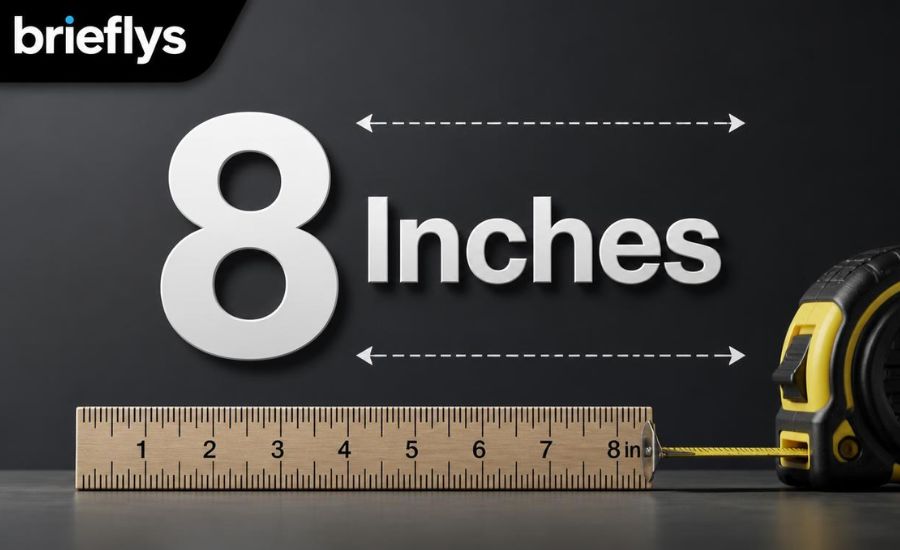
Eight inches may sound like a small measurement, but it is large enough to describe many familiar objects, from kitchen tools to electronic devices. If you do not have a ruler nearby, comparing this length with an object you recognize can make it much easier to imagine.
The exact conversion is straightforward: 8 inches equals 20.32 centimeters, 203.2 millimeters, or two-thirds of a foot. It is also approximately 0.667 feet or 0.222 yards. The National Institute of Standards and Technology (NIST) provides the conversion factor used for these calculations.
Whether you are measuring a household item, choosing a product, planning a project, or writing a size-comparison article, understanding eight inches can be surprisingly useful.
What Does 8 Inches Actually Feel Like?
Eight inches is approximately the length of a standard sheet of A5 paper along its longer edge, although A5 paper is slightly longer at 210 millimeters, or about 8.27 inches. It is also the nominal size of products such as certain cake pans and tablet displays.
Imagine placing a ruler on a table and marking the distance from zero to eight inches. That distance is just over 20 centimeters—longer than a typical smartphone’s width and shorter than the length of many full-size kitchen utensils.
The easiest way to picture eight inches is to focus on an object’s actual dimensions rather than relying entirely on memory. A ruler gives you an exact reference, while familiar objects provide a convenient visual estimate.
How Does 8 Inches Compare With a Familiar Household Object?
An A5 sheet of paper is a helpful comparison because its dimensions are standardized. According to the ISO 216 paper-size standard, A5 paper measures 148 by 210 millimeters. Its longer side is therefore about 8.27 inches, making it slightly longer than eight inches.
An eight-inch cake pan is another practical example. Wilton sells a round cake pan measuring approximately eight inches across and two inches deep. This makes it a useful household reference for visualizing the measurement.
Keep in mind that an object’s stated size may refer to its diameter, width, height, screen measurement, or usable interior dimensions. Always check which dimension is being described.
How Do You Measure 8 Inches Without Using a Ruler?
In case you don’t have a ruler, try finding something that has its measure mentioned. You can take a hint from a labelled cake tin, product details or even a standardized sheet of paper.
You can also estimate eight inches by dividing a foot into three equal sections and taking two of those sections. Since one foot equals 12 inches, two-thirds of a foot equals eight inches.
Your hand may also serve as a rough personal reference after you measure it once. However, hand sizes vary considerably, so this method is less reliable than using a measured object.
How Does 8 Inches Convert Into Different Units?
The inch is a unit of length used in the United States and several other measurement contexts. NIST confirms that one inch is exactly 2.54 centimeters. Multiplying eight by this conversion factor gives 20.32 centimeters.
Here is a quick conversion table for eight inches.
- Unit
- Equivalent
- Inches
- 8 in
- Centimeters
- 20.32 cm
- Millimeters
- 203.2 mm
- Meters
- 0.2032 m
- Feet
- 0.6667 ft, approximately
- Yards
- 0.2222 yd, approximately
- Fraction of a foot
- 2/3 ft
These values are useful for shopping, measuring furniture, comparing product specifications, and completing school or workplace calculations.
How Many Centimeters and Millimeters Make Up 8 Inches?
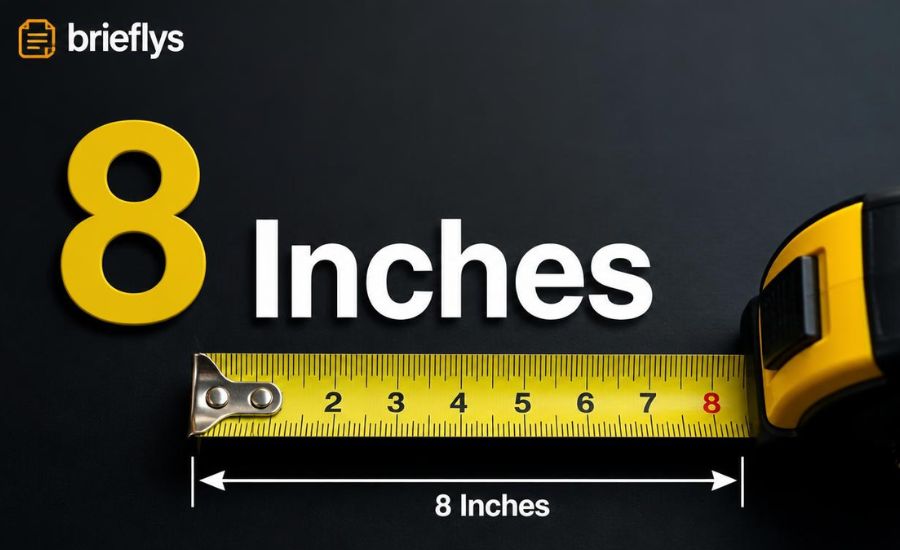
Eight inches equals 20.32 centimeters and 203.2 millimeters.
In order to change inches to centimeters, one has to multiply inches by 2.54:
8 × 2.54 = 20.32 cm.
To convert centimeters into millimeters, multiply by 10:
20.32 × 10 = 203.2 mm.
For practical use, you might round 20.32 centimeters to 20.3 centimeters when extreme precision is unnecessary. However, use the exact conversion when working with technical specifications or measurements that require accuracy.
How Does 8 Inches Compare With a Foot, Yard, and Meter?
A foot contains 12 inches, so eight inches is two-thirds of a foot. A yard contains 36 inches, making eight inches a little over one-fifth of a yard.
The meter is much longer, with one meter being 100 centimeters, whereas eight inches is 20.32 centimeters long. This means that eight inches is more than one-fifth of a meter.
These comparisons can help when reading measurements from different countries. For example, a product described as 20 centimeters long is very close to eight inches, although it is 3.2 millimeters shorter.
Why is 8 inches so common a measurement in reality?
Eight inches appears in many product categories because manufacturers can design objects around convenient dimensions. Examples include cake pans, tablet displays, tiles, kitchen accessories, and small household fixtures.
Eight inches, however, is not the standard measurement for all types of objects.Two products described as similar in size may have different external dimensions, thicknesses, or usable areas. The measurement should always be checked against the manufacturer’s specifications.
Why Do Kitchen Tools, Electronics, and Household Items Use This Size?
Manufacturers choose dimensions according to a product’s purpose. A cake pan may use an eight-inch diameter because it suits particular recipes, while a tablet may have an eight-inch screen because that size provides a compact viewing area.
The measurement can also be useful for household projects. Someone installing a shelf, selecting a tile, or choosing a small cutting board may encounter products advertised in inches.
The important distinction is that a product’s nominal size does not necessarily equal its complete outside measurement. For example, an eight-inch cake pan may have an exterior rim wider than eight inches.
When Is Knowing an 8-Inch Measurement Useful?
- Knowing the approximate size helps in several everyday situations:
- Shopping: Compare product dimensions before ordering online.
- Cooking: Choose the correct pan size for a recipe.
- Home improvement: Estimate space for fixtures, tiles, and accessories.
- Education: Solve unit-conversion problems.
- Writing: Explain object sizes in a way readers can visualize.
- Crafts: Measure materials before cutting, folding, or assembling them.
For any task where a few millimeters could matter, use a ruler or measuring tape rather than relying on visual estimation.
What Are 17 Real-Life Things That Are About 8 Inches Long?
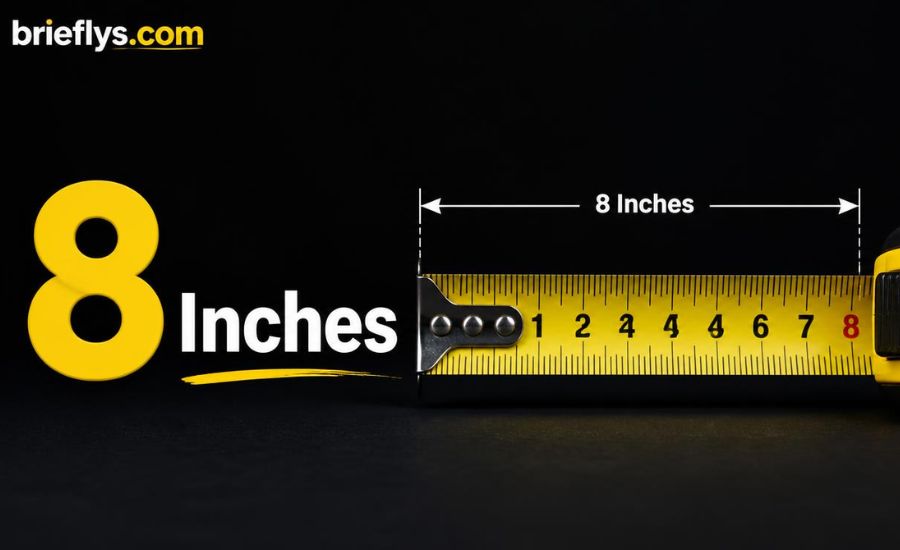
The following examples show how eight inches can appear in familiar settings. Some are products sold in a nominal eight-inch size; others are close comparisons. The dimensions are not universal, so check the exact product when precision matters.
Which Kitchen and Food Items Can Help You Visualize 8 Inches?
1. An eight-inch round cake pan
A round cake pan is one of the clearest examples. Wilton sells an eight-inch round pan with a listed depth of two inches. The stated size describes the pan’s nominal diameter, and exterior measurements can vary by design.
2. An eight-inch square cake pan
Square cake pans are also available with sides measuring eight inches. Each side gives you the target length, although the complete pan may be larger when measured across its outer edges.
3. An eight-inch pizza
Some pizzerias offer pizzas advertised as eight inches in diameter. The exact size depends on the restaurant, so this is best treated as a nominal product size rather than a universal pizza measurement.
4. An eight-inch tortilla
Tortillas are commonly sold in different diameters, and an eight-inch version can provide a useful circular comparison. Check the package specifications because tortilla sizes vary by product and brand.
5. An eight-inch chef’s knife blade
Some chef’s knives are sold with eight-inch blades. This is a particularly useful example when discussing length, but remember that the blade measurement is not the same as the total knife length, which includes the handle.
6. An eight-inch cutting board
Small cutting boards may be sold with an eight-inch width or length. Depending on the design, the other side may be longer or shorter, so check both dimensions.
7. An eight-inch plate
Some small plates measure approximately eight inches across. This provides a familiar way to picture the distance, but plates are available in many sizes and should not be assumed to measure eight inches without checking.
8. An eight-inch kitchen utensil
Certain spatulas, serving tools, and compact kitchen utensils are available in lengths close to eight inches. Their handles and working ends may differ, so compare the full length rather than judging by appearance alone.
Which Everyday Household, Office, and Technology Items Are Close to 8 Inches?
9. An eight-inch tablet display
Tablet screens are commonly marketed by their diagonal display size. TCL’s official specifications for the TCL TAB 8 list an eight-inch display and physical device dimensions of 197 × 124.8 × 8.85 millimeters. Its body is therefore about 7.76 inches tall, showing why screen size and overall device size must not be confused.
10. A5 paper
A5 paper measures 148 × 210 millimeters under the ISO 216 paper-size system. Its longer edge is approximately 8.27 inches, making it a convenient comparison that is slightly longer than eight inches.
11. An eight-inch clock
Some clocks have an advertised diameter of eight inches. This can make a useful visual reference, especially when comparing a round object with a ruler. Check whether the listed diameter refers to the clock face or the entire frame.
12. An eight-inch picture frame
Small picture frames may be sold with an eight-inch outside dimension or an eight-inch opening. These are different measurements: the outside frame includes its border, while the opening describes the space available for the picture.
13. An eight-inch shelf bracket
Some shelf brackets project approximately eight inches from a wall. This is a useful example when planning storage, but the projection, height, and mounting dimensions should be checked separately.
14. An eight-inch pipe section
A pipe can be cut to a length of eight inches, making it an exact example when measured from one end to the other. Its diameter is a separate measurement and should not be confused with its length.
15. An eight-inch tile
Square tiles are available in nominal eight-inch sizes. The measurement generally describes one side of a square tile, although actual dimensions and installation gaps can depend on the product.
16. A small notebook or planner
Some compact notebooks are close to eight inches along one edge. An A5 notebook, for instance, may be about 8.27 inches tall when positioned vertically. Covers, binding, and manufacturing tolerances can affect the finished dimensions.
17. A short household shelf or wooden strip
A small wooden strip or shelf component can be cut to exactly eight inches. Unlike products that only approximate the measurement, a piece cut with a measuring tool can provide a precise reference when its finished length is checked.
Together, these examples show that eight inches can describe a straight length, the diameter of a circle, the side of a square, or the diagonal of a screen. The measurement is the same, but the way it is used depends on the object.
What are Some Key Things to Know about 8 Inches?
Here are the key facts to remember:
- Eight inches equals exactly 20.32 centimeters.
- Eight inches equals 203.2 millimeters.
- Eight inches is two-thirds of a foot.
- Eight inches is approximately 0.2032 meters.
- NIST defines one inch as being exactly equal to 2.54 cm.
- A5 paper’s longer side is 210 millimeters, or about 8.27 inches.
- An eight-inch tablet display is measured diagonally, not necessarily along the device’s height or width.
- An eight-inch cake pan’s nominal diameter may differ from its outside diameter.
- Length, width, height, diameter, and diagonal are all dimensions of an object.
- The product specification is more accurate than the visual estimate.
- The central lesson is simple: use the correct conversion for calculations and confirm which dimension a product listing describes before relying on it.
(MCQs)
1. How many centimeters are in eight inches?
A. 18.32 cm
B. 20.32 cm
C. 22.32 cm
D. 25.40 cm
Correct answer: B. 20.32 cm
2. How many millimeters are in eight inches?
A. 80 mm
B. 200 mm
C. 203.2 mm
D. 254 mm
Correct answer: C. 203.2 mm
3. What fraction of a foot is eight inches?
A. One-third
B. One-half
C. Two-thirds
D. Three-quarters
Correct answer: C. Two-thirds
4. How is an advertised eight-inch tablet display generally measured?
A. Across the thickness
B. Along the diagonal of the display
C. Around the device’s edge
D. Across the charging port
Correct answer: B. Along the diagonal of the display
5. What is the longer side of A5 paper?
A. 148 mm
B. 180 mm
C. 200 mm
D. 210 mm
Correct answer: D. 210 mm
6. What instrument should be used to determine if an object is precisely eight inches long?
A. A ruler or measuring tape
B. A photograph without a scale
C. A guess based on appearance
D. An object’s color
Correct answer: A. A ruler or measuring tape
7. Why might an eight-inch cake pan have an outside measurement greater than eight inches?
A. The pan’s rim and construction add to its exterior dimensions
B. Inches change depending on the material
C. The metric system uses a different inch
D. All cake pans expand permanently
Correct answer: A. The pan’s rim and construction add to its exterior dimensions
Summary
Eight inches is a length of 20.32 centimeters or 203.2 millimeters.It makes up two-thirds of a foot and offers a concrete measure to comprehend the measurements of common items.
Cake pans, tablet displays, paper, kitchen tools, tiles, and household fixtures can all help illustrate this measurement. However, some examples are nominal sizes, while others are approximate comparisons. A tablet’s screen diagonal, for example, is not the same as the tablet’s height.
For more accurate results, it is best to measure using either a ruler or a measuring tape. With the correct conversion and a few familiar references, visualizing eight inches becomes much easier.